
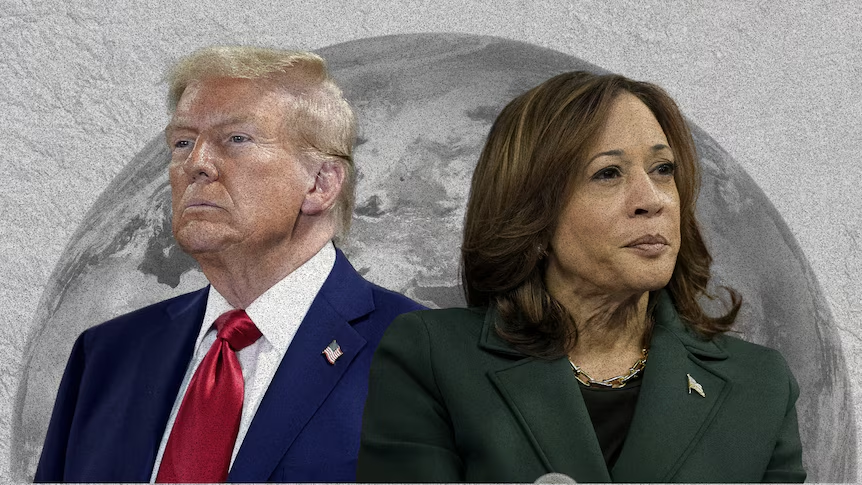
As the U.S. heads into another election, the world watches not only for political outcomes but for shifts that could impact global markets and industries. Historically, U.S. election results have influenced stock market trends, with distinct market reactions often tied to whether a Democrat or Republican is elected. For the international education sector, these shifts could have wide-reaching implications, affecting student pathways, study destinations, and investment in educational initiatives worldwide. Here, we explore historical data, key trends, and predictions to understand what the 2024 election outcome could mean for international education.
Market Trends by Party Victory: Data and Analysis
Historical market data demonstrates that U.S. elections can lead to predictable shifts in stock market trends, often influenced by party-related policies.
- Democratic Victories: Research from the CFA Institute shows that markets tend to react conservatively to Democratic wins due to perceived risks of increased corporate taxes and regulatory policies. An analysis of returns from 1932 to 2020 reveals that while initial reactions may be cautious, the long-term returns in Democratic administrations average approximately 10.3% annually, compared to 6.9% under Republicans. Government spending, particularly in education, healthcare, and infrastructure, tends to stabilize markets, creating resilience against short-term volatility.
- Republican Victories: Historically, the stock market often experiences a positive bump immediately following a Republican win, driven by expectations of corporate tax cuts and pro-business policies. The Tax Foundation found that after the Tax Cuts and Jobs Act of 2017, markets saw a 1.7% quarterly increase in business investments in the short term. While early optimism is common, the Congressional Budget Office (CBO) reports that the long-term impact can include budget deficits and interest rate increases, sometimes resulting in economic volatility.
These patterns offer insights into how the 2024 election outcome might influence global investment, as U.S. economic policies often reverberate worldwide. Understanding these trends is essential for investors, including those in international education.
Implications for International Education: Trends and Data-Driven Insights
For international education, changes in U.S. policies can significantly impact student mobility, alternative study destinations, and investment in education sectors globally.
- Pathways to and from the USA: U.S. immigration policy plays a critical role in shaping the landscape of international education. Under the Obama administration, student visas saw a steady increase, peaking at 1.2 million in 2015 before stricter policies under the Trump administration led to a drop to 1.07 million by 2019. The Institute of International Education (IIE) reports that shifts in visa policies and national rhetoric significantly influence international student enrollment. A Democratic administration typically favors more open immigration policies, leading to an increase in applications and admissions of international students, who contributed over $44 billion to the U.S. economy in 2019. In contrast, Republican administrations have historically leaned toward restrictive policies, reducing pathways to U.S. institutions and potentially redirecting students toward countries with more accessible policies.
- Alternative Study Destinations: Countries like Canada, Australia, and the U.K. have strategically positioned themselves as leading alternatives to the U.S. for international students. In 2017, when the U.S. tightened immigration controls, Canada experienced a 16% increase in international enrollments, while Australia saw a 12% rise. As American policies fluctuate, these countries often experience surges in international applications, highlighting a global shift in student mobility in response to U.S. election outcomes. If post-election policies in the U.S. restrict international access, these nations may again see increased demand, reshaping global education flows and offering students viable alternatives. For more data on trends in Canada and Australia, visit their respective education and immigration resources at Government of Canada and Australian Department of Education and Training.
- Investment in International Education: U.S. economic policy influences global investor confidence, including in education. The National Bureau of Economic Research (NBER) shows that increased U.S. spending on infrastructure and education during Democratic administrations encourages international investment, including education projects. Conversely, when the U.S. adopts a protectionist stance under Republican leadership, global investors may redirect their capital to emerging markets, which are less dependent on U.S. policies. Recent trends show rising investment interest in Southeast Asia, the Middle East, and parts of Europe. Education investment surged in regions like Singapore, Dubai, and Germany in response to the unpredictability of U.S. policies, with the global ed-tech market alone projected to grow by over 14% annually through 2025, according to Research and Markets.
Looking Ahead: A Data-Informed Perspective
Regardless of the election outcome, the U.S. remains a pivotal player in global education trends. The world of international education must stay vigilant, with an eye on data and policy changes that shape both opportunity and challenge. Leaders, investors, and students in the field should watch for changes in visa regulations, U.S.-centered education funding, and shifts in market stability that may follow election results. By understanding these historical trends and the factors influencing them, international education can navigate future shifts strategically and continue to facilitate global knowledge exchange.
As we look forward, these insights provide a roadmap to anticipate and adapt to market and policy changes, ensuring a robust and resilient future for international education and its students.
References:
- CFA Institute. Stock Market Returns by Political Party. Available at: https://www.cfainstitute.org.
- Tax Foundation. Impact of the Tax Cuts and Jobs Act on U.S. Business Investment. Available at: https://taxfoundation.org.
- Congressional Budget Office. Federal Budget and Economic Outlook. Available at: https://www.cbo.gov.
- Institute of International Education (IIE). Open Doors Report. Available at: https://www.iie.org.
- NAFSA: Association of International Educators. Economic Value of International Students. Available at: https://www.nafsa.org.
- Government of Canada. International Student Data. Available at: https://www.canada.ca/en.html; Australian Department of Education and Training. International Education Data and Reports. Available at: https://www.education.gov.au.
- National Bureau of Economic Research (NBER). U.S. Government Spending and International Investment Trends. Available at: https://www.nber.org.
- Research and Markets. Global EdTech Market Growth Projection. Available at: https://www.researchandmarkets.com.
To talk about your school project, reach us through the contact page.
If you want to learn more about the steps required to set up a school check out some of our other articles:
– Steps to Setting Up a New School
– 10 Steps and Articles on How to Set Up a New School
– GSE International School Franchise Models
About GSE
Global Services in Education plans and opens international schools for investors, developers and governments, and manages them once they are running. GSE has delivered more than 60 school and education projects across 28 countries. Management agreements run a minimum of ten years.
The company was founded in 2011 by Greg Parry and Shanna Parry.