

The school investment process is a unique path that should be travelled carefully and led by seasoned professionals. Investing in schools is unlike any other asset class. It’s part real estate, part operations, part regulation, and all mission-driven. That’s why structuring education deals requires more than spreadsheets. It requires experience, insight, and strategic alignment.
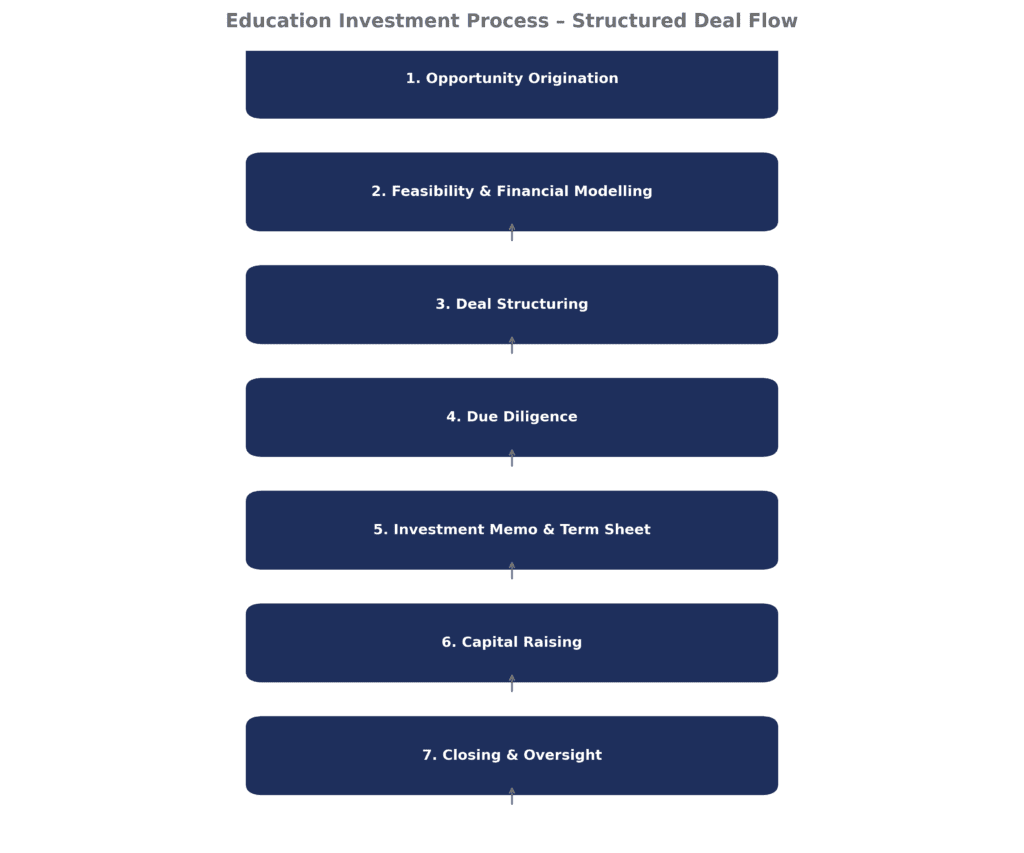
The School Investment Process
Step 1: Opportunity Origination
Every project starts with a clearly defined opportunity.
This could be:
- A greenfield school development
- The acquisition of an existing school
- A partnership with a government or foundation
- A private operator looking to scale
Our first job in the school investment process is to validate the asset: the market, the model, and the management. We assess whether the opportunity aligns with our investment thesis and whether it has long-term potential.
Step 2: Feasibility and Financial Modelling
Before we structure anything, we build the foundation: hard numbers and market evidence.
We develop:
- Market research on demographics, competitors, pricing
- Financial models with 10-year revenue, expense, and EBITDA forecasts
- Sensitivity analysis for high/medium/low scenarios
- Breakeven points and ramp-up trajectories
This step ensures investor clarity and tests the commercial logic of the project.
Step 3: Deal Structuring
This is where we shape the vehicle for investment.
Common Structures:
- SPV (Special Purpose Vehicle): Created to own and manage a single project. Keeps risk contained and investment clean.
- Sub-fund under a regulated investment fund (e.g. Malta ICAV): Ideal for global investors who need tax efficiency, transparency, and compliance.
- Equity + Leaseback: Investor owns land/building, while operator pays rent.
- JV Partnerships: Capital + operational partner share equity and responsibilities.
We work closely with lawyers and fund administrators to ensure compliance, governance, and exit flexibility.
Step 4: Due Diligence
No investor should move forward without full visibility. That’s why we guide both sides through robust due diligence.
Key Areas of Review:
- Legal: licenses, land title, incorporation docs
- Academic: curriculum, accreditations, outcomes
- Financial: audited accounts, capex, enrolment trends
- Regulatory: approvals, MOE compliance, visa rules
- Management: leadership bios, governance structure
We prepare and review data rooms that streamline decision-making and reduce surprises later.
Step 5: Investment Memorandum and Term Sheet
Once the deal is structured and the numbers are clear, we prepare:
- A full Investment Memorandum (IM) highlighting opportunity, team, market, model, and projected returns
- A detailed Term Sheet outlining key deal terms (equity %, ROI, exit rights, fees, etc.)
These documents are critical for securing capital from family offices, institutional investors, or co-investment platforms.
Step 6: Capital Raising and Investor Matching
We draw from our network of:
- Education-focused investors
- Family offices with generational alignment
- Private equity groups
- Real estate investors looking for ESG-positive assets
Our role is to match the right investor to the right opportunity, ensuring aligned risk appetite, return expectations, and vision.
Step 7: Closing and Post-Investment Oversight
Once the deal is closed, our work doesn’t stop.
We stay involved through:
- Ongoing reporting and board advisory
- Oversight of milestones and performance metrics
- Planning for future phases (expansion, refinancing, exit)
The goal is simple: protect investor capital, accelerate returns, and scale impact.
Example Snapshot: Deal Flow for a $58M Sports Academy Project
Site identified: former corporate HQ with athletic facilities
Feasibility: hybrid model with elite sports + flexible academics
Structure: SPV under regulated Malta fund + operator agreement
Forecast: Breakeven in Year 3, IRR of 24%, valuation uplift 2.5x
Status: In investor matching phase, with 3 active co-investor discussions
The School Investment Process:
Final Thought: Great Schools Need Smart Structures
Education may be a mission-driven sector, but investment in it demands professionalism. The best projects balance purpose with performance, and the smartest investors demand both.
Our job is to bridge the two: helping investors back schools that deliver returns and change lives.
About the Author
Greg Parry is CEO of Global Services in Education (GSE). He specialises in structuring education investments and launching school projects across emerging and established markets.
To talk about your school project, reach us through the contact page.