
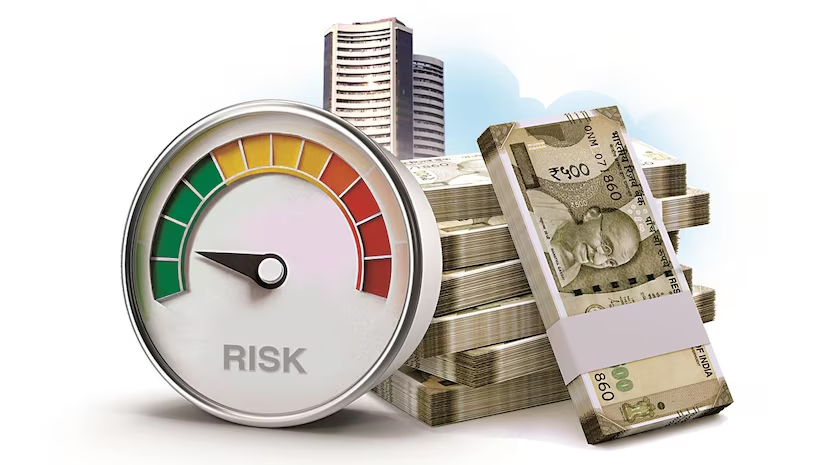
In a world of economic uncertainty, where volatility in tech, crypto, and even real estate can rattle portfolios overnight, a surprising contender has emerged as a stable and profitable alternative: International School Investments.
Once the domain of mission-driven educators and expatriate parents, international schools are now squarely in the sights of institutional investors, private equity firms, and family offices looking for long-term, asset-backed, cash-flow generating investments.
But are they really the new safe haven asset?
Let’s unpack why the answer is increasingly “yes” and what investors need to know.
What Makes International Schools Investment So Attractive?
Predictable, Recurring Revenue
Tuition fees are typically paid in advance, providing predictable income streams with minimal default risk. In premium markets, annual tuition can range from $10,000 to $40,000+ per student, across 500 to 2,000 students. That’s strong, recurring cash flow in any language.
Long-Term Commitment from Families
Education is a deeply sticky sector. Parents rarely pull students out mid-year, and most enrol for the long haul, from kindergarten through graduation. That means low churn, long customer lifecycle, and better revenue visibility.
Dual Value: Operations + Real Estate
Many international school investments come with land and buildings. This means investors benefit not just from operating profits, but from asset appreciation in prime or growing locations. Education real estate is often more resilient than commercial or retail sectors.
Recession-Resilient Demand
Even in economic downturns, families prioritise their children’s education. While luxury spending may dip, education remains a top priority, especially in emerging and expat-heavy markets.
A Global Asset with Local Anchors
As globalisation expands and families seek future-ready, English-medium, globally accredited education, international schools have transformed from niche providers to essential community pillars.
In 2000, there were around 2,500 international schools.
In 2024, there are more than 14,000 with enrolment exceeding 6.5 million students.
And yet, demand still outpaces supply in many regions.
Hot Markets for International School Investments:
- Saudi Arabia – Government policy and expat demand drive premium K-12 school growth
- Vietnam – Rising middle class seeks international pathways and bilingual programs
- Kenya & Nigeria – Massive youth populations and private-sector growth
- Mexico – High demand for American and IB schools, especially in urban centres
- Gulf States (UAE, Qatar) – Mature, competitive markets but still strong for premium brands
Well-run international schools consistently show EBITDA margins of 20 to 35%. Compare that to healthcare (10–15%), logistics (15–20%), or even hospitality (20–25%).
Financial Performance: Better Than You Think
Moreover, schools are cash-generative businesses. Once breakeven is achieved, usually within 3–5 years, revenue scales efficiently with enrolment growth while fixed costs remain relatively stable.

Private equity firms and strategic buyers are paying attention:
- Inspired Education and Nord Anglia continue to acquire schools globally.
- IMG Academy was acquired by a private equity-backed group for $1.25 billion.
Schools as Safe-Haven Assets: The Investment Case
| Feature | Safe Haven Asset? | International Schools? |
|---|---|---|
| Predictable Cash Flows | ||
| Inflation Hedge | (tuition indexed) | |
| Physical Asset Backing | (land + buildings) | |
| Low Volatility | ||
| Resilient in Downturns | ||
| Scalable and Replicable |
In short, international school investments tick every box.
What Should Investors Look For?
Not every school is a great investment.
The best-performing assets typically share these characteristics:
- Strong school leadership and academic credibility
- Brand positioning within a growing or underserved market
- Modern, scalable infrastructure that supports growth
- A licensing or accreditation advantage (IB, British, American, etc.)
- Efficient management and local compliance expertise
- An enrolment growth plan matched by capacity
Due diligence is critical. Education is operationally complex. But for well-advised investors, the returns are not only attractive but repeatable across a portfolio.

Final Thoughts: Investing in the Future
As we look to the next decade, education remains one of the few sectors that combines:
- Social impact
- Capital preservation
- Asset-backed value
- Recurring returns
In an unpredictable global market, international schools offer clarity, stability, and meaning.
And that’s the very definition of a safe haven.
To talk about your school project, reach us through the contact page.