
Investors who know real estate often assume a school building is just another commercial asset. It behaves differently. A well-let school is one of the stickiest tenancies in property: long leases, tenants that almost never move, and demand that holds up when other sectors wobble. The figure that captures all of this is the cap rate.
The capitalisation rate, or cap rate, is the clearest single measure of what an income-producing property yields. For anyone buying, building, or financing school real estate, it is the number that says what the asset earns relative to its price, and how the market reads its risk.
What a cap rate is, and why it matters
A cap rate is a property’s annual net operating income divided by its value, expressed as a percentage. It answers three questions at once: what the asset is worth, whether the income justifies the price, and how education compares with other property sectors such as office, retail, and hospitality. A higher cap rate means more income per unit of value, but it usually also signals more risk. A lower cap rate means the market is paying up for security.
Cap rate benchmarks by region
Cap rates vary widely by market, shaped by demand, the supply of credible operators, lease structures, and perceived risk. The ranges below reflect stable, leased school assets with established operators. Build-to-own or operator-run schools sit on a different profile.
| Region | Typical Cap Rate (%) | Key Notes |
|---|---|---|
| UAE (Dubai, Abu Dhabi) | 6.0 – 7.5% | Strong demand, established school brands, premium land |
| Saudi Arabia (Riyadh, Jeddah) | 7.0 – 9.0% | High growth, long lease terms, large-scale developments |
| Vietnam / Southeast Asia | 6.5 – 8.5% | Rising demand, limited institutional school operators |
| Africa (e.g., Kenya, Ghana) | 8.0 – 10.5% | Strong upside, higher perceived risk and lower liquidity |
| UK & Europe (Tier-1 cities) | 4.5 – 6.0% | Lower yields but strong asset security and reputation |
| Mexico / Latin America | 7.5 – 9.5% | Strong tuition growth, currency/inflation impact varies |
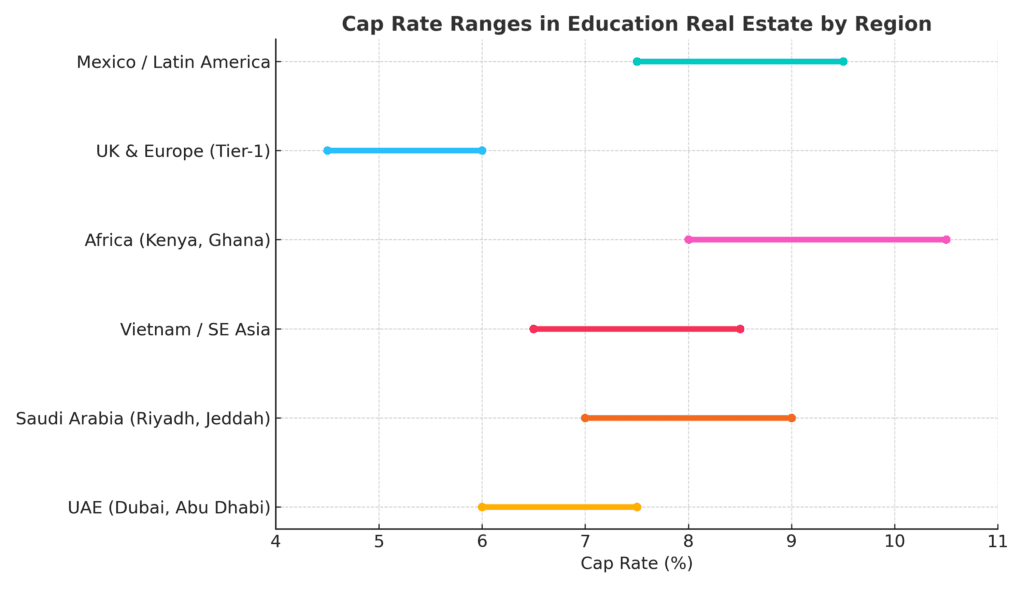
The pattern is consistent. Mature, supply-constrained markets such as the UK and parts of Europe trade at the lowest yields, because the asset security and reputation are worth paying for. Higher-growth markets in Africa and Latin America offer wider yields that also carry currency, liquidity, and regulatory risk. A lower cap rate is not a weaker deal. In education it often signals exactly the tenant security and reputational strength serious investors want.
What makes education real estate distinctive
Long leases
Schools sign long. Lease terms of fifteen to twenty-five years are common, often with indexed escalations, which gives the owner a predictable, inflation-linked income stream that few other sectors match.
Tenants that rarely move
A school invests heavily in its building, its fit-out, and its local brand. Once established, it almost never relocates. That makes schools among the stickiest tenants in commercial property.
Resilient demand
Demand for education holds up through downturns, and in some markets strengthens when families pull back from other spending. That stability feeds straight into the reliability of the income.
Land that appreciates
Schools often sit on large parcels in expanding urban areas. As land grows scarce, those sites appreciate, adding capital growth on top of the rental yield.
Three ways investors hold education real estate
Leaseback
The investor owns or develops the property and leases it to a school operator, taking a stable, indexed rental income. It suits education-focused REITs and long-term income portfolios that want the asset without the operating risk.
Build, operate, and hold
The investor develops the school and runs it directly, capturing both the operating income and the property’s appreciation. It suits family offices and funds that have, or can bring in, genuine operating expertise.
Hybrid: joint venture or management agreement
The investor owns the asset but brings in a specialist operator, splitting the return or paying a management fee. This is the structure most large, scalable education investments use, because it separates capital from operations while keeping both accountable. It is the logic behind the PropCo/OpCo model and the education management organisation.
What moves the cap rate on a school deal
Several factors push a school’s cap rate up or down:
- Location quality and land value, urban against suburban
- The operator’s brand and demonstrated quality of education
- The length of the lease and its escalation structure
- Regulation, including licensing, fee caps, and foreign-ownership rules
- Local demographics and enrolment trends
- Market liquidity, meaning how easily the asset can be resold or refinanced
How education compares with other asset classes
Set against other property sectors, education real estate occupies an attractive middle ground: yields comparable to commercial property, with a materially lower risk profile.
| Asset Type | Typical Cap Rate | Risk Profile |
|---|---|---|
| Education Real Estate | 5.5% – 9.5% | Medium-Low |
| Commercial Office | 6% – 10% | Medium-High |
| Hospitality (Hotels) | 7% – 12% | High |
| Industrial | 5% – 7% | Medium |
| Residential | 3.5% – 5.5% | Low |
Education sits above residential on yield but below hospitality and office, and it does so with lower volatility than either. That combination, commercial-grade returns with defensive characteristics, is why institutional capital has moved into the sector.
Working with GSE
A school’s value as a property is inseparable from how well it is run. The strongest returns come to investors who structure the real estate and the operation together, rather than treating the building as a standalone asset. With 39 school projects delivered across 16 countries, GSE works with investors across the full lifecycle, from feasibility and structuring through development and long-term management. To discuss a school property you are evaluating or building, talk to our team.