
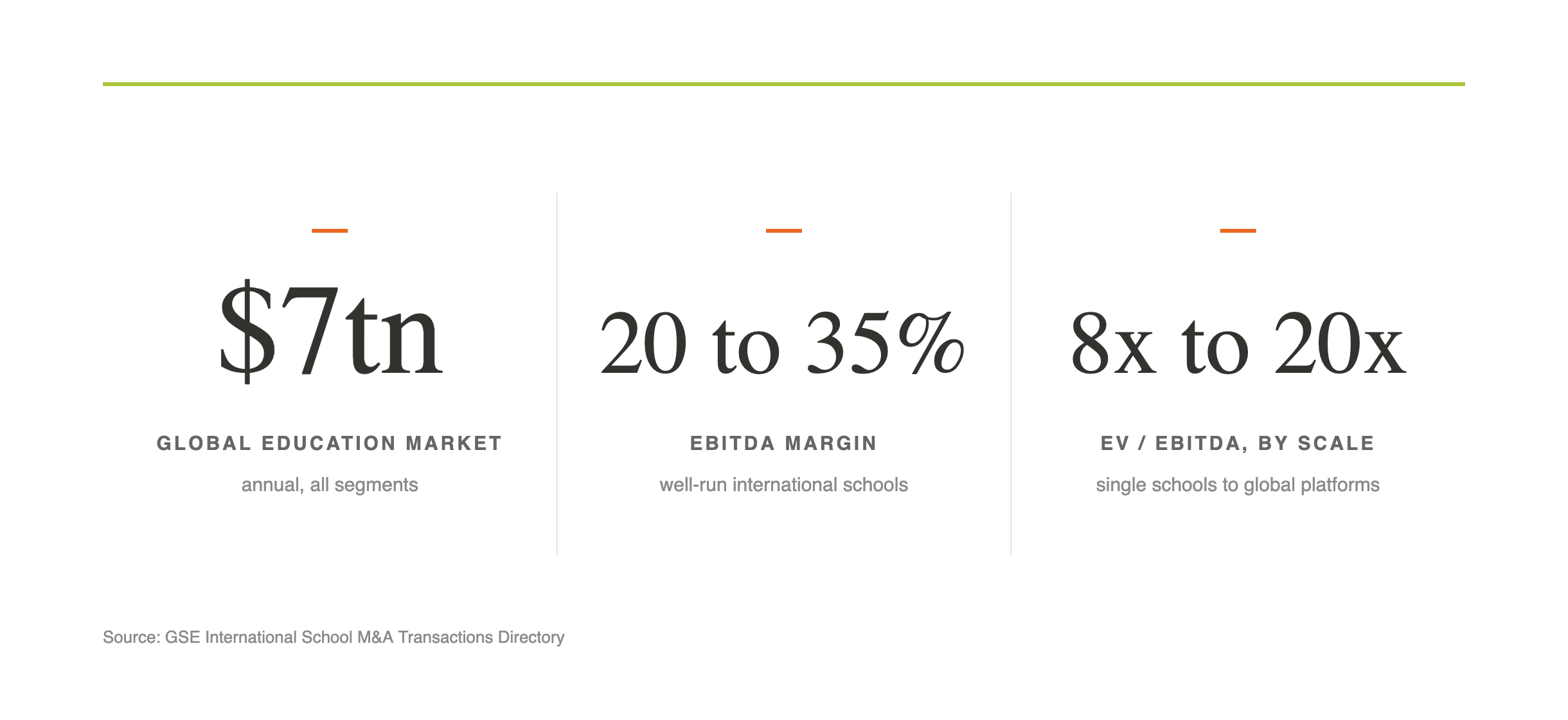
Private equity has been buying schools at institutional scale for a decade. KKR into Cognita, Baring Private Equity Asia and CPPIB taking Nord Anglia private at USD 4.3bn in 2017, the EQT-led consortium completing at USD 14.5bn in March 2025, OMERS Private Equity alongside Partners Group into International Schools Partnership. The sector is validated. The capital is not the question any more.
What is still worth writing down is why the playbook that works almost everywhere else damages this asset, and why the damage takes two years to appear in the numbers.
The improvements that work in most businesses cost you enrolment here
A school is bought because it has recurring revenue, a customer relationship that can run twelve years or more, and obvious operational slack. Most groups are genuinely underleveraged on management systems, facility utilisation and cost structure. All of that is true, and it is why the sector attracts capital.
The error is treating what follows as a conventional margin exercise. Parent satisfaction, teacher quality, curriculum integrity and regulatory standing are not variables that can be optimised away without consequence. They are the product. Groups that have pushed short-term financial performance ahead of educational quality have consistently seen enrolment fall, regulators tighten and reputation erode, and none of those reverse quickly. The structural version of that argument sits in why most new school projects fail financially.
The lag is what makes it dangerous. Cut something a family values in September and nothing happens. Families do not withdraw mid-year, and the following year’s enrolment was largely settled before the cut. The effect lands at the next admissions cycle but one, by which point the person who made the decision has a year of improved margin to point at.
Two years is longer than most hold-period reporting looks
That timing problem is the reason patient capital has done better here. The strongest returns in international school investment have come from five to ten-year horizons rather than from quick exits, and it is not because schools are sentimental assets. It is because the feedback loop on an operating decision is roughly two admissions cycles, so a three-year hold can exit before its own damage becomes visible in the accounts.
It also means the second owner inherits the first owner’s decisions with a delay. That is worth pricing in diligence rather than discovering afterwards, and it is covered in what happens when private equity buys a school.
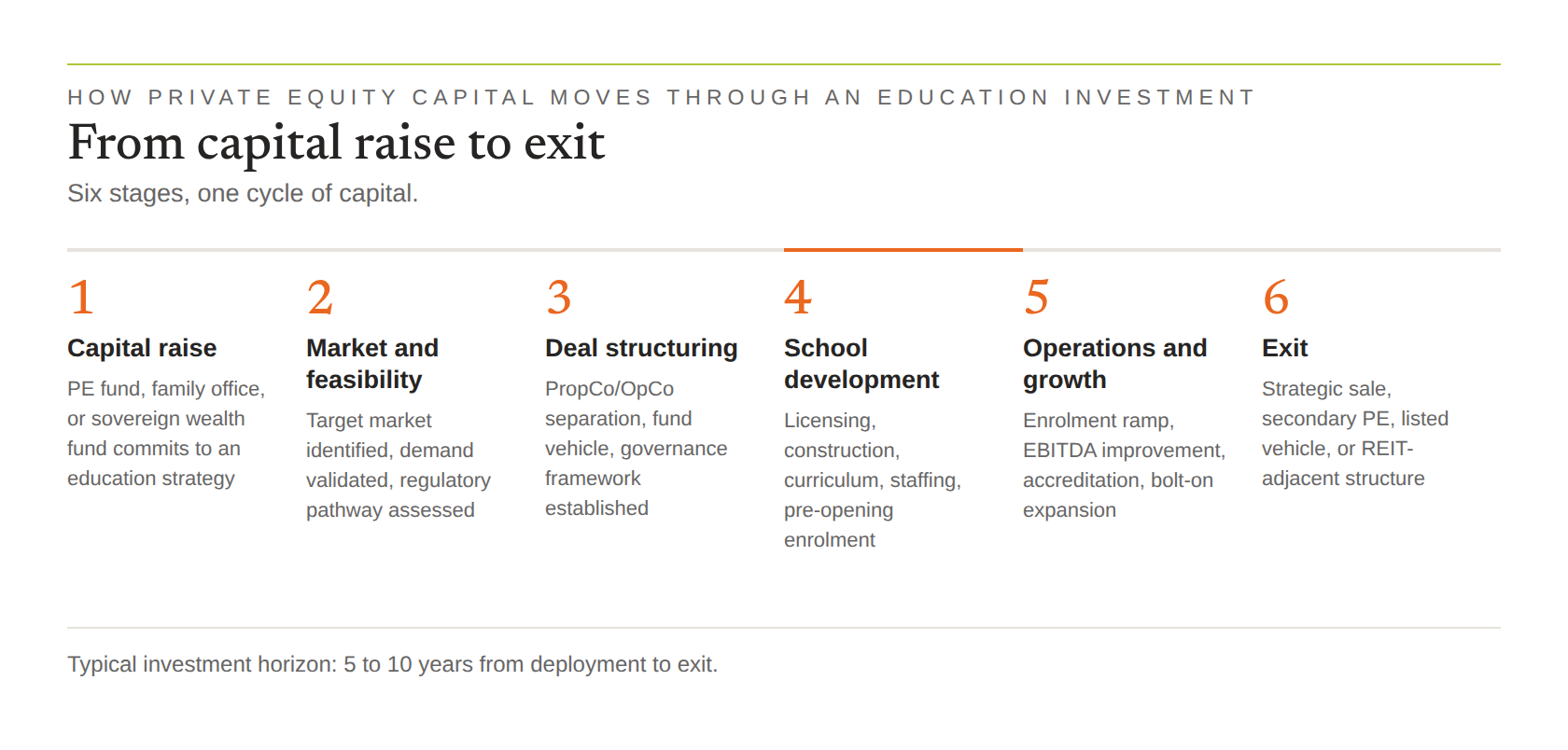
Set the operating lag against the shape of the investment and the mismatch is obvious. The capital raise, the platform acquisition, the bolt-on programme and the exit each run to their own timetable, and none of them is two admissions cycles long. Diligence at acquisition is the only stage where the previous owner’s lag is still visible, and it is the stage most often compressed.
Regulatory complexity does not travel, and neither does the model
Licensing, curriculum approval, fee regulation and ownership restrictions vary enormously between markets. A model that works in Dubai does not transfer to Saudi Arabia, and neither transfers to Malaysia or Kenya. Investors entering without specialist knowledge of the regulatory environment meet delays, cost overruns and compliance problems that erode the return before the operating thesis is ever tested.
Fee elasticity behaves the same way. An IB school in Dubai or Singapore prices in a fundamentally different environment from a British curriculum school in a secondary Southeast Asian city. Bolt-on growth across geographies is the standard thesis in this sector, and it is the point at which the assumption that a model travels does the most damage.
International K-12 is the largest and most established segment for private equity in education, and the thesis is consistent across the landmark deals: acquire a quality operator with a proven curriculum and management model, then apply capital to geographic expansion and facilities. The thesis is sound. What varies is whether the operator being acquired actually holds the thing the model assumes it holds, which is a management team capable of running the standard in a market it has not worked in before.
Management depth is an acquisition criterion, not a post-close task
Capital is necessary and not sufficient. The quality of the leadership team, the curriculum framework, the culture and the community relationships determine whether a school holds its market. Investors who treat these as operational details to be sorted after completion consistently underperform against their own underwriting.
The same applies to accreditation planning and to governance frameworks. Both take years, both produce evidence a buyer will eventually want, and neither can be assembled in the months before an exit.
What the numbers look like when it is done properly
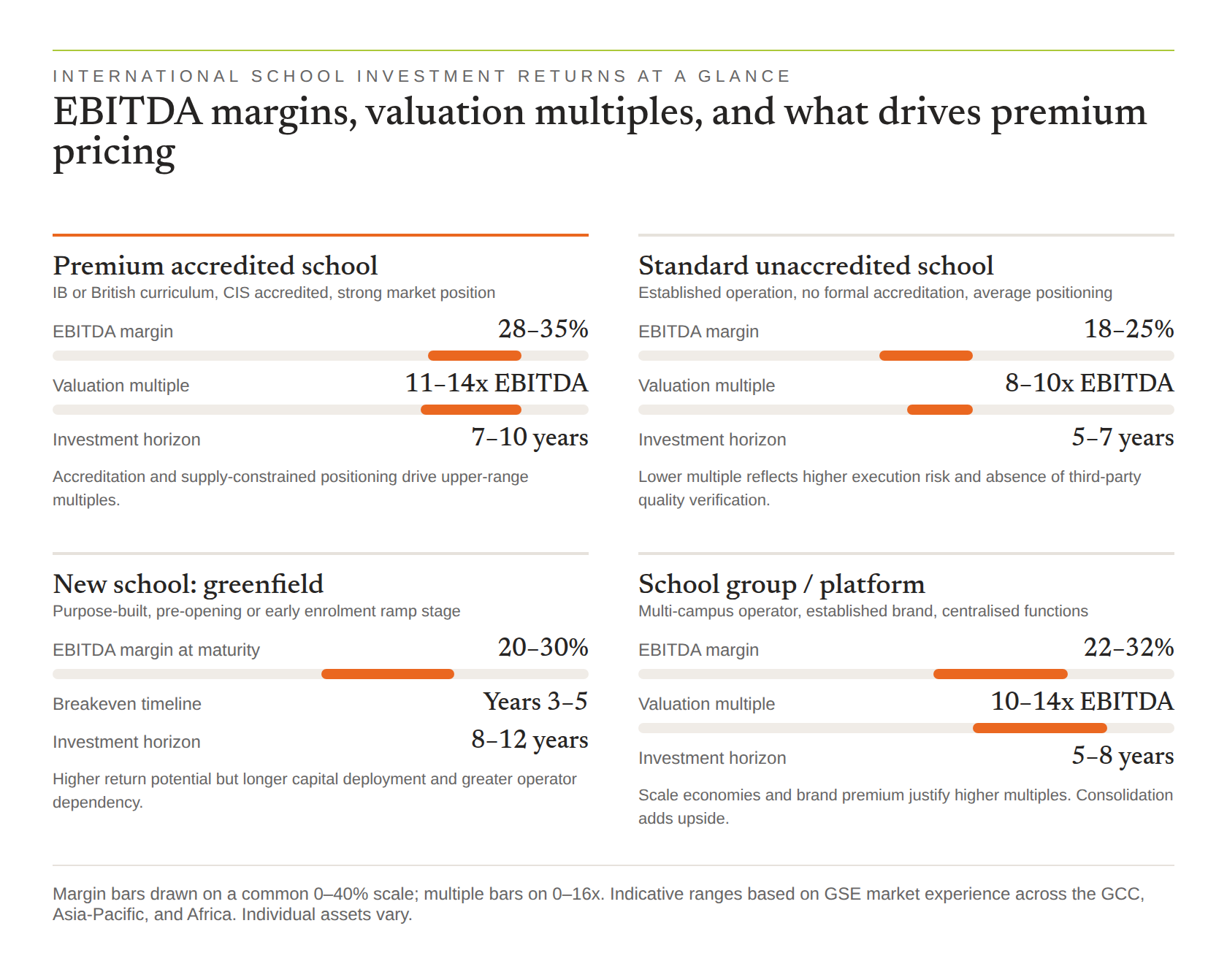
EBITDA margins in well-run international schools typically run between 20 and 35 per cent at school level, with group margins depending heavily on central cost structure and debt servicing. The EBITDA benchmarks carry the detail.
Multiples vary sharply with scale. Individual schools and established groups in the mid-market have historically transacted at around 8 to 14 times EBITDA. That band sits above the wider education sector: Berkery Noyes put the median disclosed education transaction in 2024 at 1.6 times revenue and 7.9 times EBITDA. Premium single assets and regional platforms in supply-constrained markets have been underwritten at 12 to 17 times. Scaled global platforms sit well above that, in the high teens to low twenties, and the Nord Anglia transaction agreed in October 2024 at an enterprise value of USD 14.5 billion is the clearest example of a trophy platform pricing outside the mid-market range altogether.
The cleanest anchor available is Wendel’s disclosure on Globeducate, where the published enterprise value and earnings imply 16.7 times including IFRS 16 and 19.4 times excluding it. Two and a half turns of multiple from an accounting treatment rather than from anything about the schools, which is a useful reminder that a quoted multiple is incomplete without its basis. The underlying entries sit in the International School M&A Transactions Directory, and the methodologies they feed are in how to value an international school.
Structure follows the operating problem, not the other way round
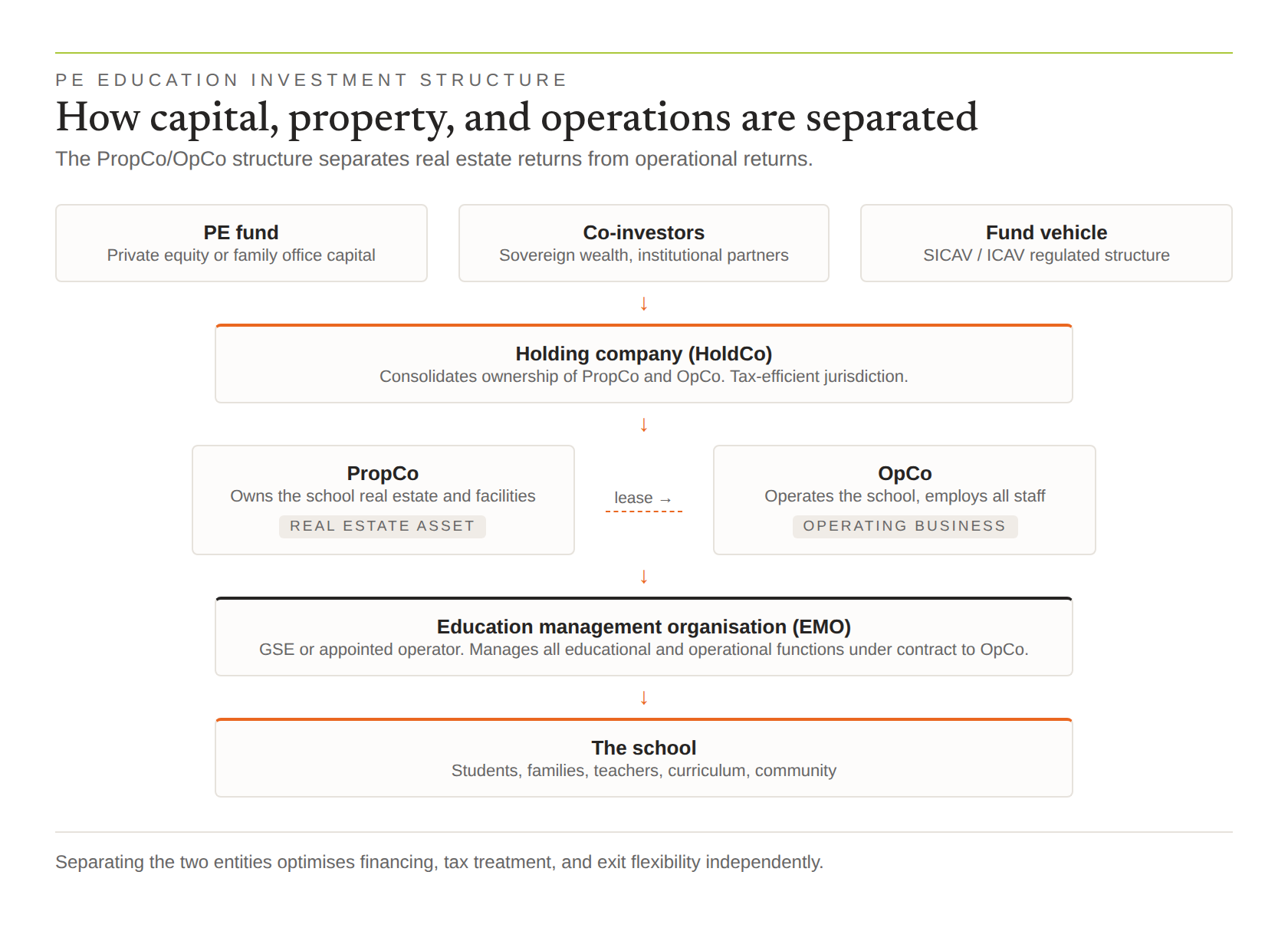
Direct investment through standard fund structures remains the most common route. Co-investment alongside specialist managers has grown as larger institutions seek exposure without building sector expertise internally. Regulated vehicles, including Malta SICAVs and Irish ICAVs, are used where capital is aggregated across jurisdictions, and they allow education property and operating businesses to sit inside one regulated structure with appropriate separation.
Separating property from operations through a PropCo/OpCo structure changes what each half is worth and how each is financed. It is a structural decision with operating consequences, which is the order it should be taken in.
The habits that separate the investors who do well
They engage operators who know the sector at the outset rather than applying a generic improvement playbook to an institution they do not understand. They build accreditation and regulatory work into the thesis and the timeline rather than treating them as tasks for after completion. They structure governance to protect the culture and community trust that drive enrolment rather than subordinating both to a monthly metric.
And they hold long enough to see their own decisions arrive.
Read next
- What Happens When Private Equity Buys a School. Hold periods, the first year under new ownership and what changes on the ground.
- International School M&A Transactions Directory. Verified deal prices, EBITDA multiples and the open dataset, with every figure graded by source.
- How to Value an International School. The three methodologies and what drives premium against discount valuation.
- Exit Strategies in Education: Who is Buying and What They Are Paying. The five exit routes, who the acquirers are and how they price.
- EBITDA Benchmarks: How Profitable Are International Schools?. Margin evidence across the sector and what drives the spread.

To talk about your school project, reach us through the contact page.