
Every organisation, school or group seems to have a Vision and/or Mission to guide its activities and goals but sadly there is often a disconnect. It becomes a plaque on a wall, a catch phrase for marketing or a throw away line at major events. There is no question that Vision and Mission are important but how do we make them meaningful? We suggest you replace your Vision and Mission.
“Sadly many schools give lip service to a vision and mission but these documents and statements are not congruent with behaviours. In fact what we describe as Signature Experiences that are supposed to reflect true organisational values can in fact be contradictions. Your goal should be Vision and Mission Integrity“
Greg Parry (CEO)
Lets firstly clarify the difference between Vision and Mission
The vision statement tends to focus on tomorrow and what the organisation wants to become. It will tend to respond to questions such as: What are your hopes and dreams? What problem are we solving for the greater good? Who and what are we inspiring to change? It will focus on growth and what matters most to the future of the group.
The mission statement focuses on today and what the organisation or school actually does. It will tend to respond to questions such as: What do we do? Whom do we serve? How do we serve them?
Maybe it is time to replace your vision and mission with a driver that makes a greater difference.
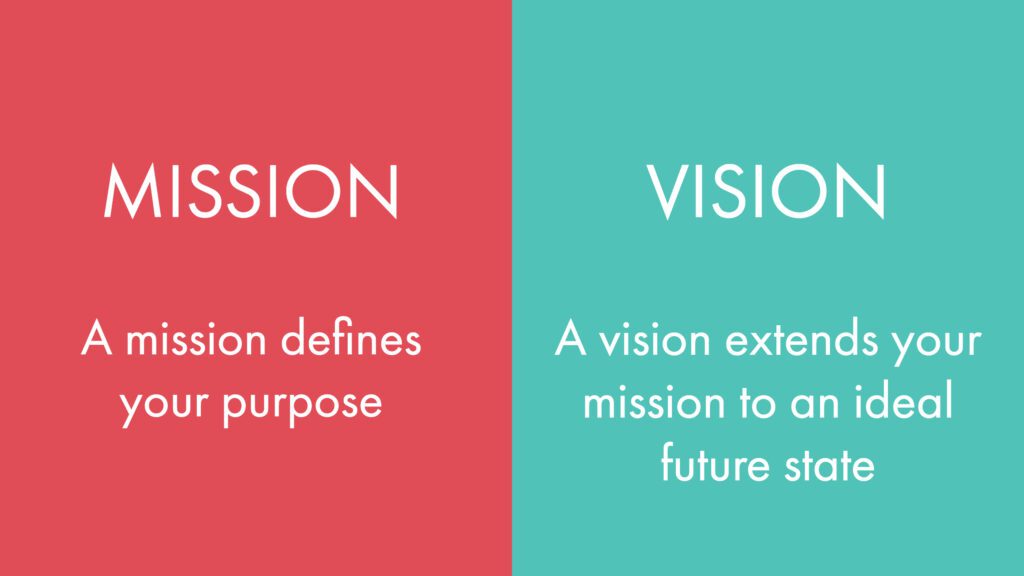
While companies commonly use mission and vision statements interchangeably, it’s important to have both.
On a daily operational basis however, my challenge to you is to replace Vision and Mission with something more tangible.
Our frank advice is to leave your vision and mission on the wall but in practice replace it with a guiding question.

“Will this action, activity, decision, project, purchase or direction….. <insert key vision words> “
It is important to operationalise a vision and mission to make sure we truly embrace it. The ideas must be grounded and relevant for all.
Let’s clarify what this actually looks like in practice:
A committee is debating the pros and cons of a very important decision. They are swinging backwards and forwards, including discussion about how to operationalise the plan. It has a budget attached to it, it requires investment of time and might require prioritising as compared to other initiatives. Some key members are passionate and determined, others are objecting and there are many in the middle not sure what steps to take.
The chairperson takes a pause and reminds all stakeholders of “the guiding question that should determine all that we do”.
Suddenly the decision making gets easy……
Here is an example:
Company: Tesla
Mission: To accelerate the world’s transition to sustainable energy.
Vision: To create the most compelling car company of the 21st century by driving the world’s transition to electric vehicles.
A Guiding Question: Will this action, activity, decision, project, purchase or direction deliver sustainable energy practices? (Example only)
Replace your Vision and Mission and make it a key guiding question that is more relatable and tangible.
For a school it might look like this:
Mission: Valuing Our Future – Maximising Potential
Vision: To ensure all children have a clear personal mission of a preferred future and they engage in ways that maximise their potential to achieve it
Guiding Question: Will this action, activity, decision, project, purchase or direction maximise student potential?
The next challenge I pitch to you is to consider what values will underpin your practices. You might have rules, policies and procedures but there must be a belief system that drives good decision making and aligns behaviours. Sadly many organisations are quick to create handbooks and bound rule books that are inches thick but if our touch point is a value system then this is far more effective than “let me check in our handbook” approach to operations. When a challenge, decision or opportunity enters your mind you should automatically process first steps through the use of a guiding question and filtered by actions guided by an agreed value system.
A set of values will become the foundation that shapes how we behave ethically and what our personal behaviours look like, in order to achieve vision and mission. Replace your Vision and Mission with a guiding question.
Here is an example of core values from Apple (1981):
- One person, one computer.
- We are going for it and we will set aggressive goals.
- We are all on the adventure together.
- We build products we believe in.
- We are here to make a positive difference in society, as well as make a profit.
- Each person is important; each has the opportunity and the obligation to make a difference.
- We are all in it together, win or lose.
- We are enthusiastic!
- We are creative; we set the pace.
- We want everyone to enjoy the adventure we are on together.
- We care about what we do.
- We want to create an environment in which Apple values flourish.
Here is an example from a GSE School (Kingsgate) :
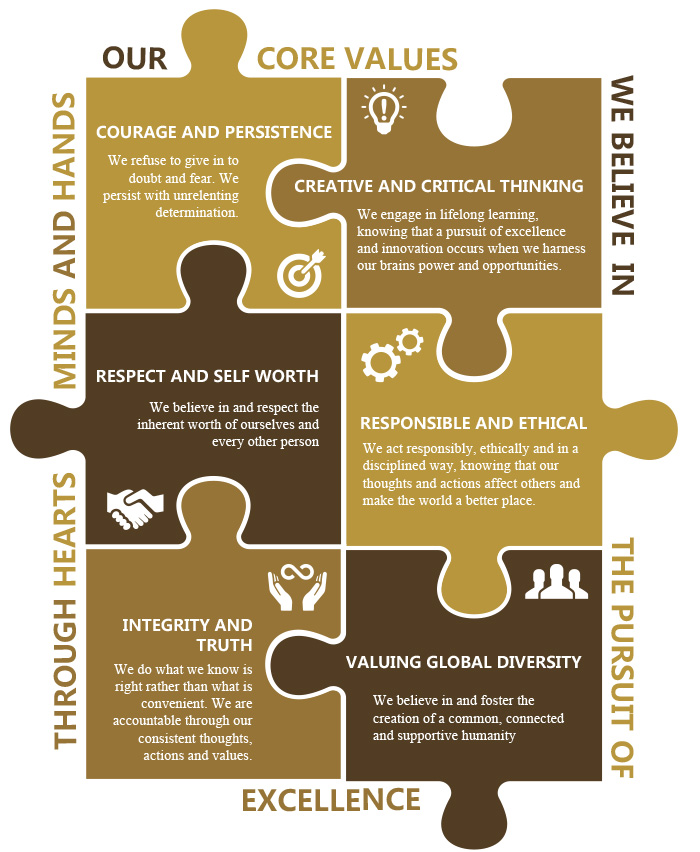
It is essential to create integrity by aligning all that we do with a common purpose. Catch cries just don’t cut it!
We need to operationalise vision, mission and values by ensuring that all we do is guided by common and shared behaviours that look “almost the same, most of the time.”
Global Services in Education (GSE) is highly focussed on making a difference. In fact we are education and investment advisors to a number of education groups, schools, investors, investment funds and start up groups with a mission to improve the quality of education in all regions of the world.
This idea is developed further in GSE’s white paper, Vision and Mission Integrity, where the guiding question becomes the Alignment Question, the first tier of a practical audit for testing whether a school’s mission actually governs its decisions. The full paper is free to download.
About GSE
Global Services in Education plans and opens international schools for investors, developers and governments, and manages them once they are running. GSE has delivered more than 60 school and education projects across 28 countries. Management agreements run a minimum of ten years.
The company was founded in 2011 by Greg Parry and Shanna Parry.