
Most valuation conversations open with the multiple. Eight times, twelve times, seventeen times. It gets negotiated hardest because it is the part everyone can see.
It is the easiest part of the exercise. A multiple is arithmetic applied once the difficult question has been settled, and the difficult question is not what the school earned last year.
A buyer is paying for next year’s enrolment. The accounts describe last year’s.
The multiple is the easy part
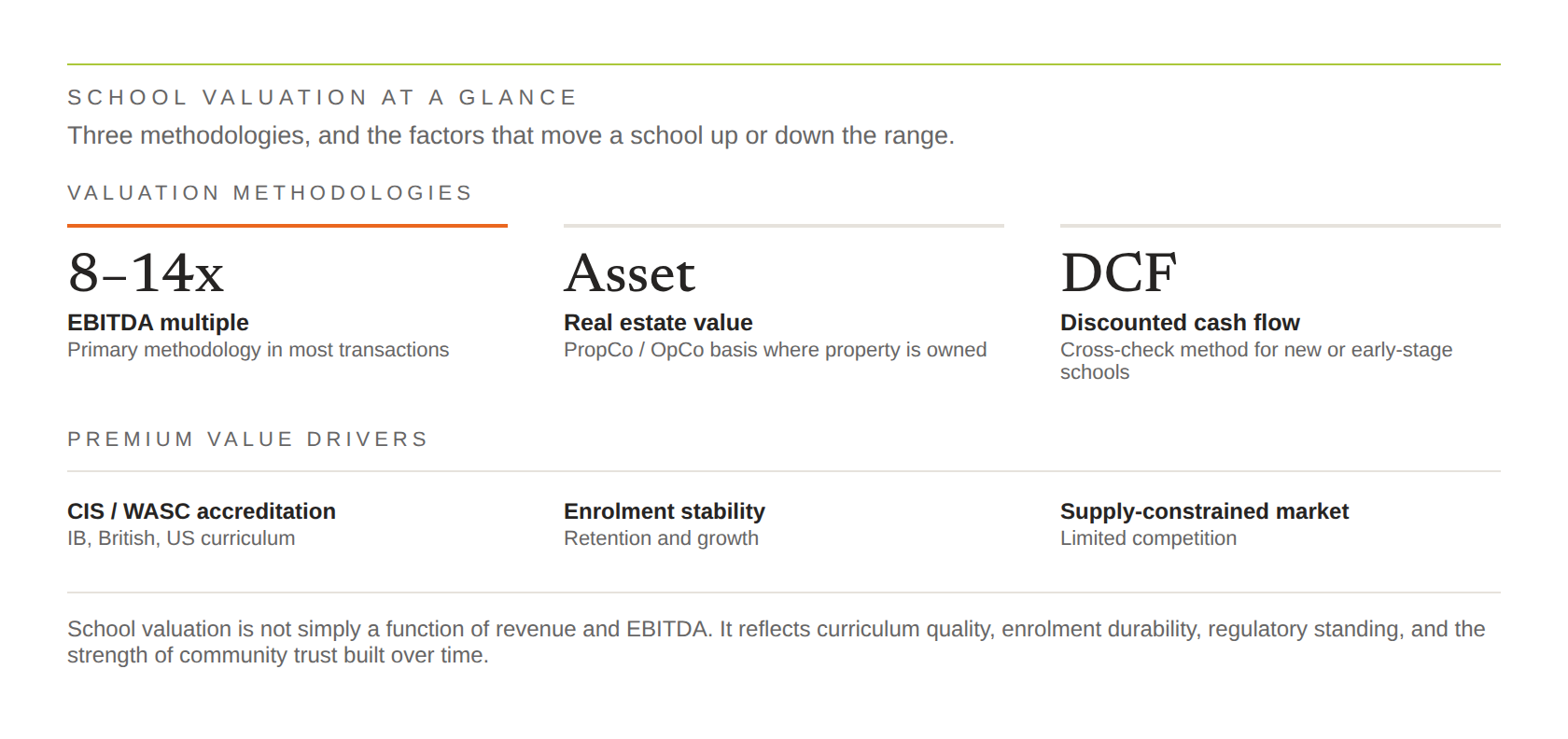
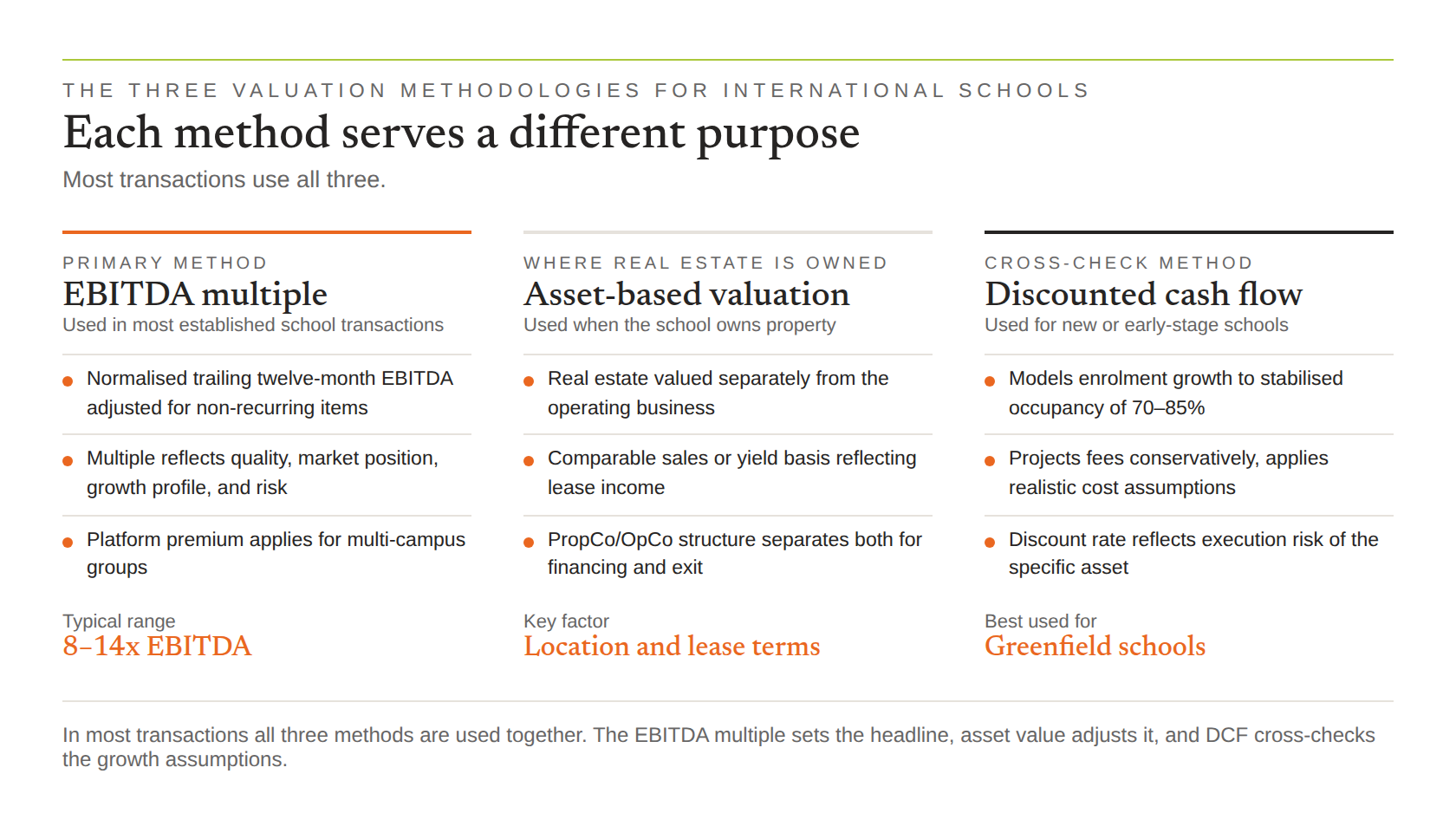
The standard method for international school transactions is an EBITDA multiple. A normalised EBITDA figure, usually trailing twelve months adjusted for non-recurring items and owner-specific costs, is multiplied by a factor reflecting quality, market position, growth and risk.
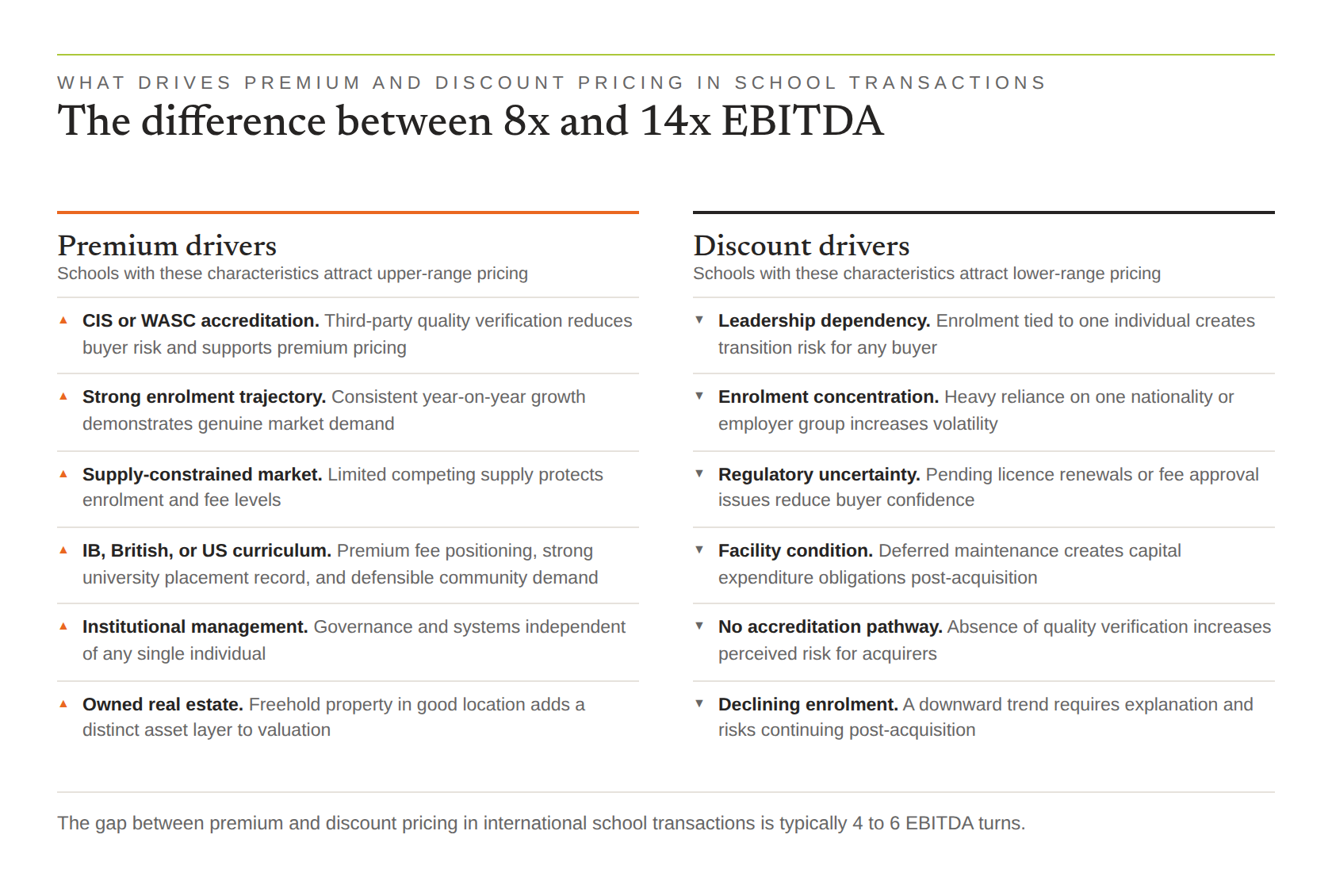
The ranges are reasonably well established. Around 8 times for schools with modest scale or higher risk. Twelve to fourteen times for established schools with durable enrolment and credible management. Premium assets in supply-constrained markets with a proven record of enrolment growth reach the mid to high teens, at times 17 times. CIS-accredited schools in undersupplied markets sit at the upper end.
Groups attract a platform premium. Five schools are worth more than five times one school, because of scale economies, risk spread across sites and the optionality a buyer gains for further expansion.
None of that is contested. Both sides of a transaction usually agree the method inside an hour. The argument that matters is about what belongs in the EBITDA figure and whether it will still be there in twelve months. The margin the figure rests on is the assumption most often taken on faith.
You are buying next year’s enrolment
A school’s enrolment is not a customer list. It is a set of families who chose the school, one year at a time, and who will choose again in a window that opens months before the fees are collected.
Two schools can report the same trailing EBITDA while running very different businesses. One re-enrols above ninety per cent of its families each year and holds a waitlist at the entry points. The other re-enrols in the mid seventies and refills from a market that is getting more crowded. The profit and loss accounts look similar. The second school is worth materially less, and the difference does not appear anywhere in the historic numbers.
The first figure worth asking for is the re-enrolment rate by year group, three years back. It is the closest thing this sector has to a leading indicator, and a seller who cannot produce it either does not track it or would rather not show it. Either answer is informative.
What actually predicts whether families come back
The drivers below are usually presented as a list of value factors. They are better read as evidence for one question.
- Waitlist depth, measured properly. An expression-of-interest list is a marketing asset. Applications with deposits paid, at named year groups, are a forecast.
- Sibling enrolment rate. Families who put a second child in are giving the clearest verdict available on whether they intend to stay.
- Where the losses sit. Attrition concentrated at natural transition points is a feature of international schooling. Attrition spread evenly across year groups is a symptom.
- Nationality and employer concentration. A school drawing heavily on one expatriate community carries that community’s labour market inside its enrolment forecast. One corporate relocation or one visa policy change moves the roll.
- Fee headroom. A school priced below what its quality and market position support has value a buyer can realise. A school already at the top of what its market will bear has spent that option.
- Accreditation and curriculum standing. Credible international accreditation shortens the queue of questions a buyer’s lenders will ask, and it travels with the school rather than with the owner.
- Facilities against the promise. Buildings that no longer match what the fee level implies produce a capital requirement the seller has usually deferred, and deferred capital is a price adjustment.
When the earnings are attached to a person
Leadership dependency is the discount factor most consistently underestimated in this sector.
A Head who has built a school over many years carries relationships with families, staff and the regulator that do not appear on any schedule in the data room. When that person leaves around a change of ownership, and they often do, some proportion of the enrolment forecast leaves with them. The buyer has paid a multiple on earnings that were partly personal.
The test is whether the school runs on systems or on a person. Documented admissions processes, a functioning senior team with defined responsibilities, an academic monitoring cycle that exists in writing, a board that governs rather than administers. Where those things are present, the transition is a recruitment exercise. Where they are absent, the buyer is acquiring a reputation with a notice period attached.
This is also why the sequencing of the leadership appointment matters more than most transaction timetables allow for. A school changing owner and Head in the same admissions cycle is running two risks at once, against families who are making their own decision in the same months.
The building is a different asset, and a different question
Where a school owns its real estate, the property needs to be valued separately from the operating business. The PropCo and OpCo split that has become standard in international school transactions exists to let each be recognised and financed on its own terms.
Property is valued on comparable sales or on the yield implied by the lease income it takes from the operating entity. School real estate in strong locations on long leases tends to price at a premium to general commercial property, because the tenant is difficult to displace and the use is essential to the families it serves.
There is a trap in that arrangement, and it is common. Where the rent between the two entities was never set at arm’s length, the operating business will look either better or worse than it is, and the multiple gets applied to a distorted figure. A buyer taking the OpCo at a market rent it has never actually paid is underwriting a margin that has not been tested. There is also no market rent for a school in the sense a valuer would recognise, which is why this resolves before any multiple is discussed. It changes the number the multiple is applied to.
Where a school occupies leased premises, the asset component matters far less and the whole valuation rests on the operating business, which returns the exercise to enrolment.
Discounted cash flow, and where it earns its place
DCF is a cross-check in most completed school transactions rather than the primary method. It comes into its own for greenfield and early-stage schools, where there is little earnings history and the case rests on a credible enrolment trajectory.
A DCF for a new school models the roll from opening to stabilised occupancy, typically 70 to 85 per cent of capacity, projects fees conservatively, applies realistic operating costs and discounts at a rate reflecting execution risk. The discount rate applied to a school in a proven market with an experienced operator differs materially from one applied in an untested location without that record. The model is only as good as the ramp assumption inside it, and the ramp assumption is a judgement about how quickly families will commit to a school that does not yet exist.
How thin the evidence really is
The multiple ranges above are drawn from transaction evidence rather than theory, and anyone using them should understand how few observations sit underneath.
GSE maintains a public record of international school transactions, graded by the strength of each figure’s source. Of 121 entries, four disclose an EBITDA amount. One of those is a process that never completed, one is a listed operator reference rather than a transaction, and one carries an enterprise value graded as an estimate. A single completed acquisition of operating schools in that file discloses both a price and an EBITDA amount on party-published evidence.
Two consequences follow. Comparables should be graded before they are used, and a figure should never be carried into a model at a confidence higher than its source supports. And the identity of the parties matters. A price agreed between affiliated vehicles is weaker evidence of what an unrelated buyer would pay than a price produced by a contested process, and the sector’s most quoted valuation anchor was set that way.
What we want to see before putting a number on a school
The following is the working list, in the order it usually gets asked for.
- Re-enrolment rate by year group, three years, with the definition used.
- Application to enrolment conversion, and the deposit position on the current waitlist.
- Nationality and employer mix of the current roll.
- Fee history against local benchmarks, and the last three fee increase decisions with their enrolment effect.
- Staff turnover, teaching separated from support, and the current contract cycle.
- Licence status, inspection history and any open regulatory conditions.
- Lease terms, and whether any inter-company rent was set at arm’s length.
- Deferred capital, with a view on what the fee level obliges the school to spend.
A seller who can produce that set quickly is usually running a school worth buying. The exercise of assembling it tends to answer the valuation question before the multiple is argued over.

Read next
Read next: The ranges quoted above rest on a public record thin enough that the count of underlying observations is worth seeing. International School M&A Transactions Directory
To talk about your school project, reach us through the contact page.