
Active Learning
Why is ‘Active learning’ important as opposed to the isolation or memorisation of facts and figures?In short active learning requires children to be involved and engaged in with an activity. It requires children to be doing something that develops their understanding and practical application of their skill base. Problem solving, open ended questions, reflection and critical thinking are some of the skills used, but not limited to, when being actively involved with learning. It is the opposite of being given facts and figures with the expectation of memorising and accepting the answers as being correct. Through ‘Active learning’, children are engaged and challenged to why and how they think using real-life and imaginary situations
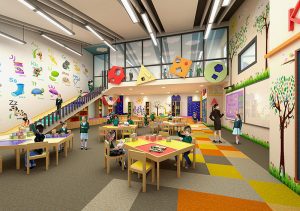
A GSE Designed Classroom
Why is active learning important?
As a tool ‘Active Learning and Play’ brings together children’s ideas, feelings, relationships and physical aspects of the environment. In this way, they develop their understanding of things that they encounter in their immediate surroundings or new social situations. Simply put ‘Active learning’ enables children to learn new ideas, theories and concepts by building upon what they already know to higher levels of thinking without requiring a set goal or target to achieve. It allows the children to think critically, problem solve and find their own solutions and answers. To achieve this, learning is supported through ‘concrete experiences’, or what is referred to as ‘hands on’ learning by interacting with their environment. This is carried out through interactive tasks that require children to plan and go through a variety of processes to understand their end goal. In short, active learning is important as children can develop their ideas and understanding using an ever-growing variety of practical interactions and implementation of processes which are built upon via self-initiated activities—moving, listening, searching, feeling, talking, experimenting and manipulating objects. This in turn supports the child’s understanding of the world around them, along with the life skills that they required to be an active participant of the community.What are the challenges for active learning?
The challenge lies in the extent to which adult’s guide and support children’s play as being a powerful vehicle for learning without controlling or setting goals, targets or expectations for potential learning. As adults, we must consider the children’s ability to experiment and explore their understanding when finding their own solutions to develop necessary processes to seek out answers for themselves. Care is required not to put time restraints, barriers or boundaries for learning. There is a requirement to respect each child whom has individual potential with their own interests and ways of understanding which is unique to them. Learn how active learning is approached through curriculum: Read more Want to learn more about play? Read more – What are the principles of high quality play?About GSE
Global Services in Education plans and opens international schools for investors, developers and governments, and manages them once they are running. GSE has delivered more than 60 school and education projects across 28 countries. Management agreements run a minimum of ten years.
The company was founded in 2011 by Greg Parry and Shanna Parry.