
High quality play is spontaneous
The value and principles of high quality play can be and have been widely debated. Rather than viewing play as a way of using excess energy it can also be viewed as rewarding, motivating and challenging while being used to meet the individuals needs or requirements to learn a new skill. What we know though is that the very best high quality play is spontaneous. Through ‘Play’, children are learning at a level that has relevance to their understanding. As such play presents itself in many formats. Thus, there is no right or wrong way of learning.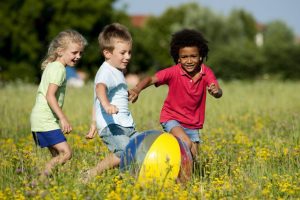 Recognizing that ‘A Child’s Play’, is spontaneous is key to recognising how it supports holistic development. While many debates have been put forward it is widely accepted that ‘Children Playing’, is universal, enabling thought processes and subsequent life skills across all contexts to be developed. In conjunction to this ‘Play’, for any child is highly motivating, self-regulating and does not hold any boundaries for ongoing exploration and the acquisition of higher thinking skills.
Through play, children explore their world and learn to take responsibility for their own choices. Curiosity about the world, taking initiatives, problem solving and persistence are just a few approaches to learning that children develop through play. In other words, the ways they respond to lifelong learning.
In summary, High Quality Play:
⇒ is an intrinsic part of children’s learning and development.
⇒ has many possible, but no prescriptive, outcomes.
⇒ challenges children and offers them the chance to learn in breadth and depth.
⇒ draws on what children already know and can do and enables them to master what is new.
⇒ enables children to apply existing knowledge and to practise their skills
⇒ encourages children to communicate with others as they investigate or solve problems.
⇒ offers children opportunities to explore feelings and relationships, ideas, and materials, connections and consequences.
⇒ empowers children to make choices, to solve problems and to be independent in their learning.
⇒ enables children to express fears or relive anxious experiences in controlled and safe situations.
⇒ encourages children to struggle, to take risks and to become resilient as learners.
⇒ can be supported and extended but not interfered with by adults.
⇒ presents no barriers to children because of their language, cultures, abilities or gender.
Recognizing that ‘A Child’s Play’, is spontaneous is key to recognising how it supports holistic development. While many debates have been put forward it is widely accepted that ‘Children Playing’, is universal, enabling thought processes and subsequent life skills across all contexts to be developed. In conjunction to this ‘Play’, for any child is highly motivating, self-regulating and does not hold any boundaries for ongoing exploration and the acquisition of higher thinking skills.
Through play, children explore their world and learn to take responsibility for their own choices. Curiosity about the world, taking initiatives, problem solving and persistence are just a few approaches to learning that children develop through play. In other words, the ways they respond to lifelong learning.
In summary, High Quality Play:
⇒ is an intrinsic part of children’s learning and development.
⇒ has many possible, but no prescriptive, outcomes.
⇒ challenges children and offers them the chance to learn in breadth and depth.
⇒ draws on what children already know and can do and enables them to master what is new.
⇒ enables children to apply existing knowledge and to practise their skills
⇒ encourages children to communicate with others as they investigate or solve problems.
⇒ offers children opportunities to explore feelings and relationships, ideas, and materials, connections and consequences.
⇒ empowers children to make choices, to solve problems and to be independent in their learning.
⇒ enables children to express fears or relive anxious experiences in controlled and safe situations.
⇒ encourages children to struggle, to take risks and to become resilient as learners.
⇒ can be supported and extended but not interfered with by adults.
⇒ presents no barriers to children because of their language, cultures, abilities or gender.
About GSE
Global Services in Education plans and opens international schools for investors, developers and governments, and manages them once they are running. GSE has delivered more than 60 school and education projects across 28 countries. Management agreements run a minimum of ten years.
The company was founded in 2011 by Greg Parry and Shanna Parry.