

If the management team is not trusted to manage, the solution is to replace them, not to govern around them.
That sentence settles most governance arguments in schools, and almost every board that is in trouble has avoided it. The board that sits in on staffing decisions and the board that meets twice a year and nods are usually the same board at different stages, and both have made the same underlying mistake. Neither has decided what it is actually for.
Governance is the part of school development that investors talk about least and worry about most. It gets left until after the capital is committed, which is the wrong order, because by then the structure has already been set by whoever was in the room.
Both governance failures are the same failure
The first is a board too involved in operations. Members who weigh in on staffing, curriculum choices or daily matters undermine the authority of the leadership team and blur who is accountable for what. It usually comes from good intentions and it always produces the same result: a head who cannot lead and a board that cannot hold anyone to account, because it has become part of the thing it is meant to be assessing.
The second is a board that has disengaged. It meets infrequently, accepts whatever reporting it is given, and defers to management without challenge. That is not governance. It is cover. And when performance turns, a disengaged board is the least equipped body in the school to intervene, because it has not maintained the information flow that would let it see the problem early or the standing to act on it.
Both come from the same place. The board never defined its own job, so it drifted into either doing someone else’s or doing none.
What the board is actually for
Strategic direction, financial oversight, leadership evaluation, risk and regulatory compliance. Not daily operations, not routine staffing, not classroom practice. The job is to set the direction, hold the leadership team accountable for delivering it, and balance the interests of owners, investors and the school community when those pull apart.
An effective school board is not a committee of enthusiasts. It is a structured body with defined responsibilities, relevant expertise, clear accountability to the owners and enough independence to exercise real oversight of the people it appointed.
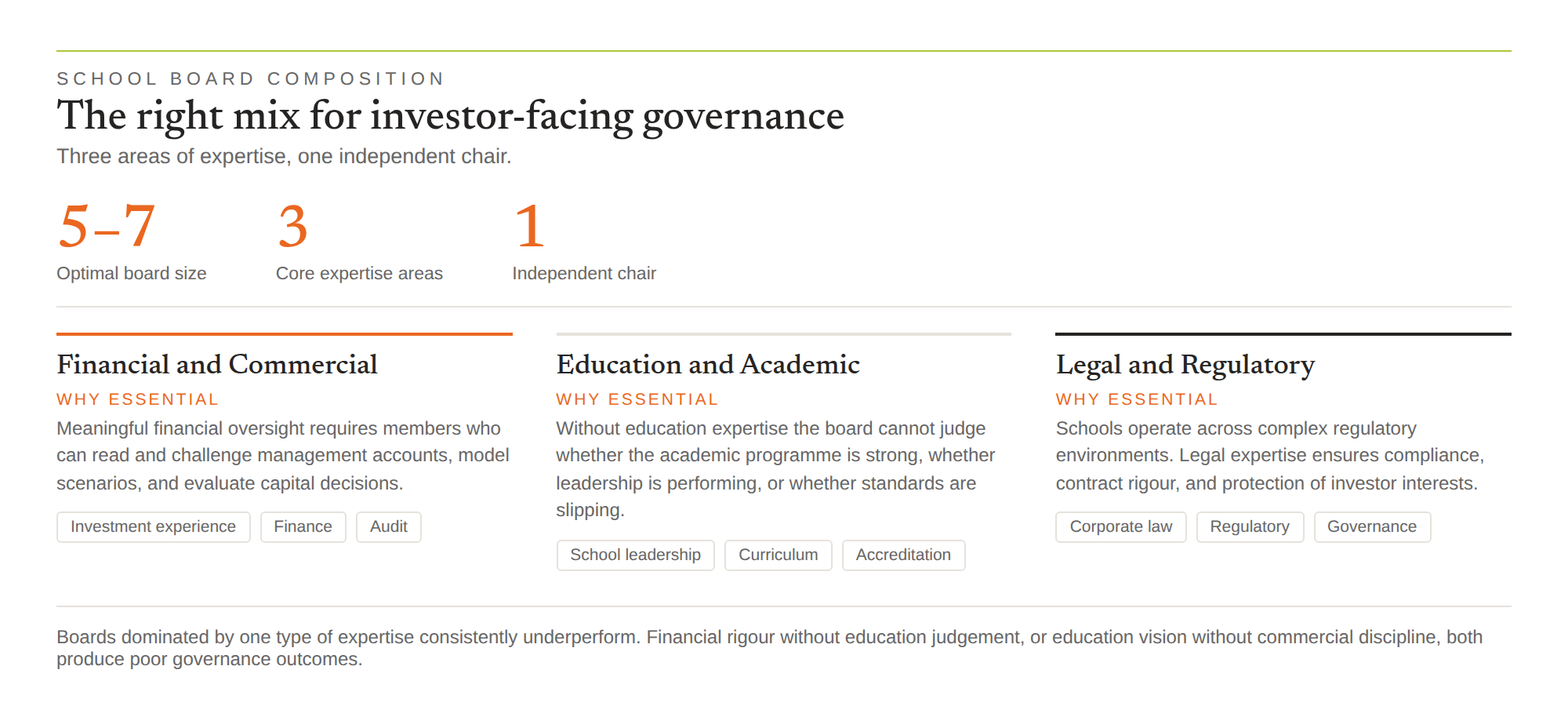
Composition matters more than size. A board without financial literacy cannot test a budget. A board without educational expertise cannot judge whether an academic explanation is sound or convenient. A board with neither is dependent on management for its own understanding of the school, which is the condition that produces the second failure mode.
Ownership clarity comes before any of it
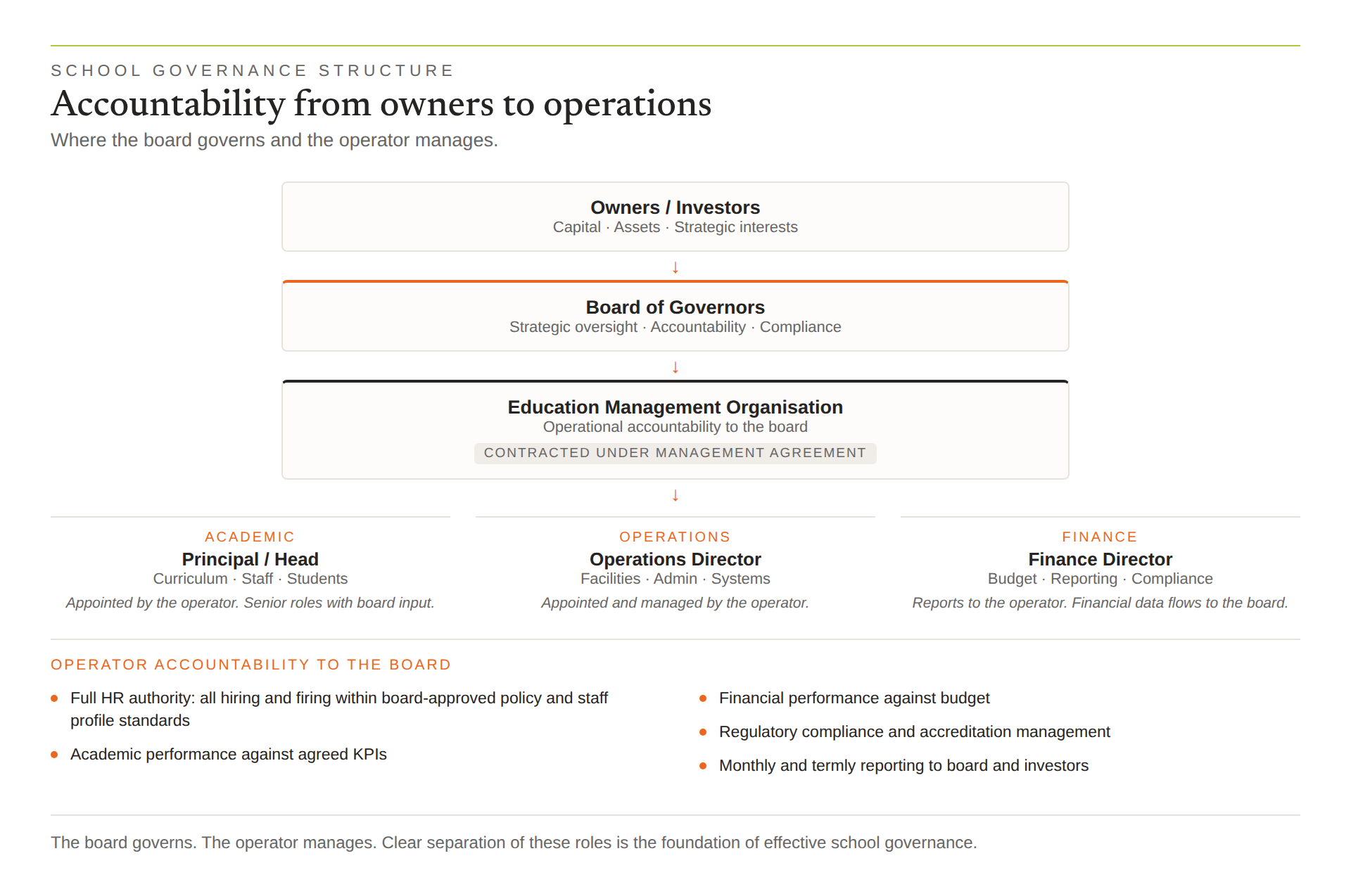
Before a board is constituted, the ownership structure has to answer two questions without ambiguity. Who owns the assets, and who controls operational decisions. In a PropCo/OpCo structure the first answer is split between two companies. In a single-entity structure it is not. Either works, provided the governance framework reflects which one is in place.
The second question is the one that gets skipped. Asset ownership and operational control frequently sit with different parties, particularly where an education management organisation runs the school under a management contract. The framework has to define the boundary between owner oversight and operational authority clearly enough that neither side is guessing. Where it does not, the boundary gets tested during the first crisis, which is the worst possible time to discover it was never agreed.
A board can only govern on the information it receives
Governance without information is governance in name only. At minimum: monthly financial reporting against budget, termly academic data covering enrolment, retention, results and accreditation status, and an annual strategic review against the long-term plan. Consistent formats, so trends are visible rather than snapshots.
Financial reporting alone will not show the school’s real condition. Enrolment pipeline, staff retention, parent satisfaction, regulatory correspondence and leadership stability are the indicators that move first. A school in difficulty usually shows it in staff turnover and admissions enquiries a year before it shows it in the accounts.
The framework also needs defined escalation. What triggers board involvement, at what threshold, and how quickly. A board that has agreed this in advance can act early. A board that has not will debate whether it is allowed to act while the problem compounds.
Scaling a platform multiplies the boundary, not just the sites
Governance complexity rises with each campus, and structures that work for one school rarely survive being stretched informally across several. The workable pattern is a group board holding strategic direction, capital allocation and group standards, with campus-level accountability for operations, and an explicit definition of where centralised oversight ends and local autonomy begins.
Standardised reporting across campuses is not administrative tidiness. An investor in a multi-campus platform cannot assess comparative performance without comparable data, and a group that cannot produce it is asking to be valued on the weakest campus it cannot explain.
Investors will impose governance if you have not built it
Governance is not something arranged after the investment closes. It is a precondition for the investment being available on good terms. A project approaching institutional capital without a clear ownership structure, a credible board, a defined accountability framework and a working reporting system is not investment-ready, however strong the projections or the educational vision.
Investors in that position do one of two things. They decline, or they impose governance as a condition, on terms that are rarely as favourable to the founders as what they would have designed themselves. Governance quality is also one of the primary drivers of premium valuation in school transactions, so the work is paid for either way. The only question is whether the owner does it early and keeps the terms, or late and accepts someone else’s.
Durability is the point
The purpose of governance in a school is not compliance. It is durability. A school with a board that knows its job survives a difficult year, a leadership transition, an accreditation cycle and a growing parent community without losing investor confidence or community trust.
Which returns to where this started. A board earns the right to hold leadership accountable by not doing leadership’s job, and it earns the right to be trusted by asking for the information it needs before it needs it.
Read next
- The 360-Degree School Review. Governance is the first thing a diagnostic review tests, and usually the first thing that has to be fixed.
- The PropCo / OpCo Model in School Development Explained. Why the ownership split decides which board governs what.
- The School Management Contract. Where owner oversight ends and operational authority begins.
- How to Value an International School. What governance quality is worth at exit.
- Private Equity in Education. What institutional capital expects to find already in place.

To talk about your school project, reach us through the contact page.
Part of GSE’s What We Believe collection.