
A school management contract decides who is accountable for the result. Everything else in it is detail.
Most owners read it as a service agreement. Who does what, for how much, for how long. Read that way it gets negotiated like a procurement document, on price and term. Then the school opens, underperforms, and the contract turns out to have been the wrong instrument, because nobody can say whose problem the underperformance is.
The contracts worth signing answer that question on the first page.
What a school management contract is
A school management contract is a formal agreement between a school owner, investor or board and a specialist management organisation. The management organisation takes operational responsibility for running the school on the owner’s behalf. That usually covers academic leadership, staffing, curriculum delivery, financial oversight, regulatory compliance, and parent and community relations.
The owner keeps legal ownership of the school and its assets. The management organisation takes accountability for outcomes. That split between ownership and operational control is the defining feature of the arrangement and the source of most of the complexity around it.
It appears in several situations. An investor who has developed or acquired a campus without the education expertise to run it. A school group entering a new market and buying local operational capability. A government body raising standards in a publicly funded institution under a performance-based contract. A board bringing in a specialist organisation to stabilise a school that is failing.
The contract delegates defined operational authority while preserving the owner’s strategic oversight and financial interest. The management organisation appoints or approves senior leadership, runs daily operations, oversees curriculum and academic performance, handles recruitment, manages regulatory and accreditation relationships, and reports against agreed indicators. The owner approves major financial decisions, sets strategic direction, monitors performance, and can terminate if obligations are not met.
How clearly the contract draws that boundary determines almost everything that follows. Vague contracts produce the same friction every time. The operator feels undermined by interference in daily decisions. The owner feels uninformed about their own asset.
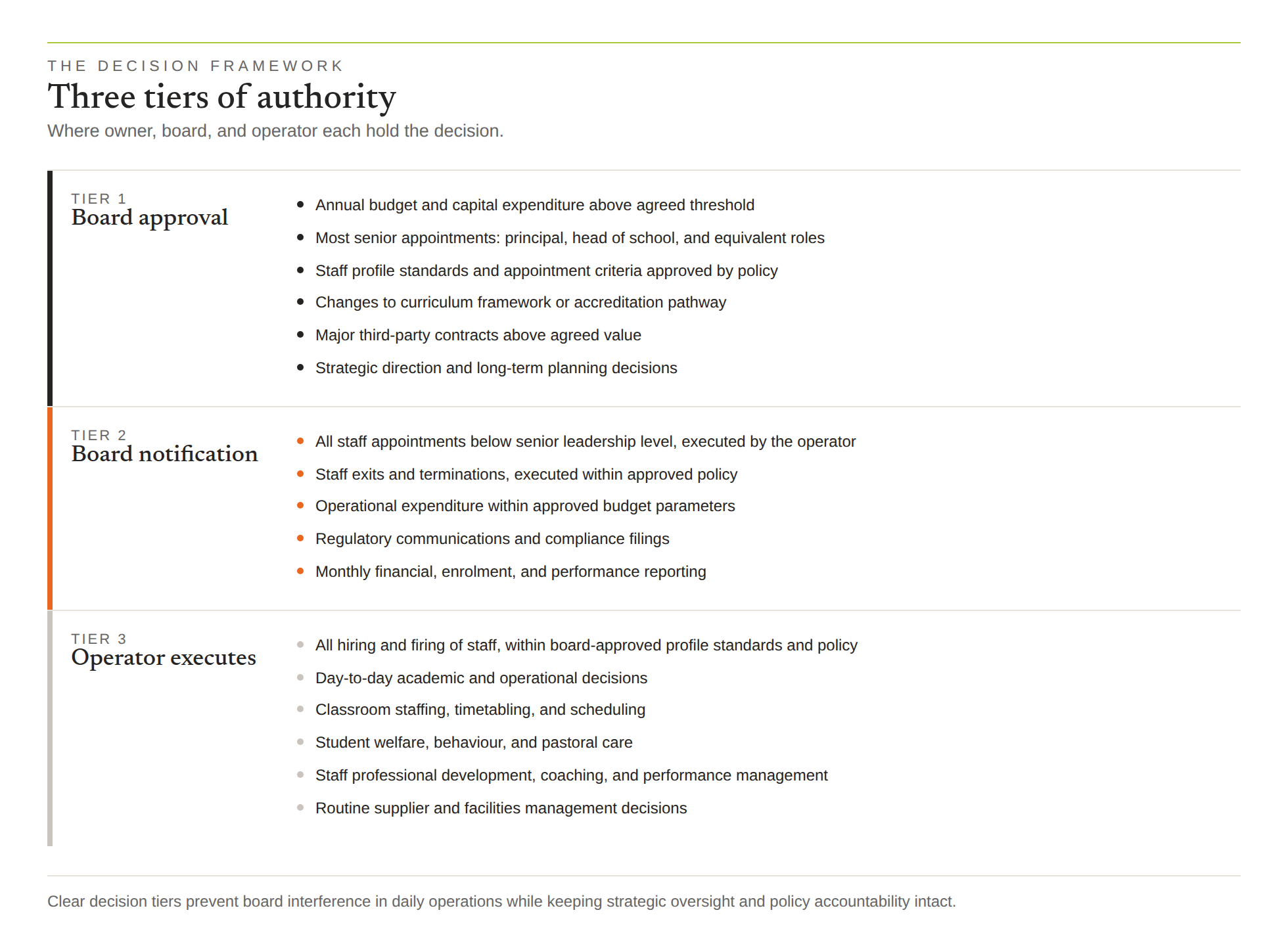
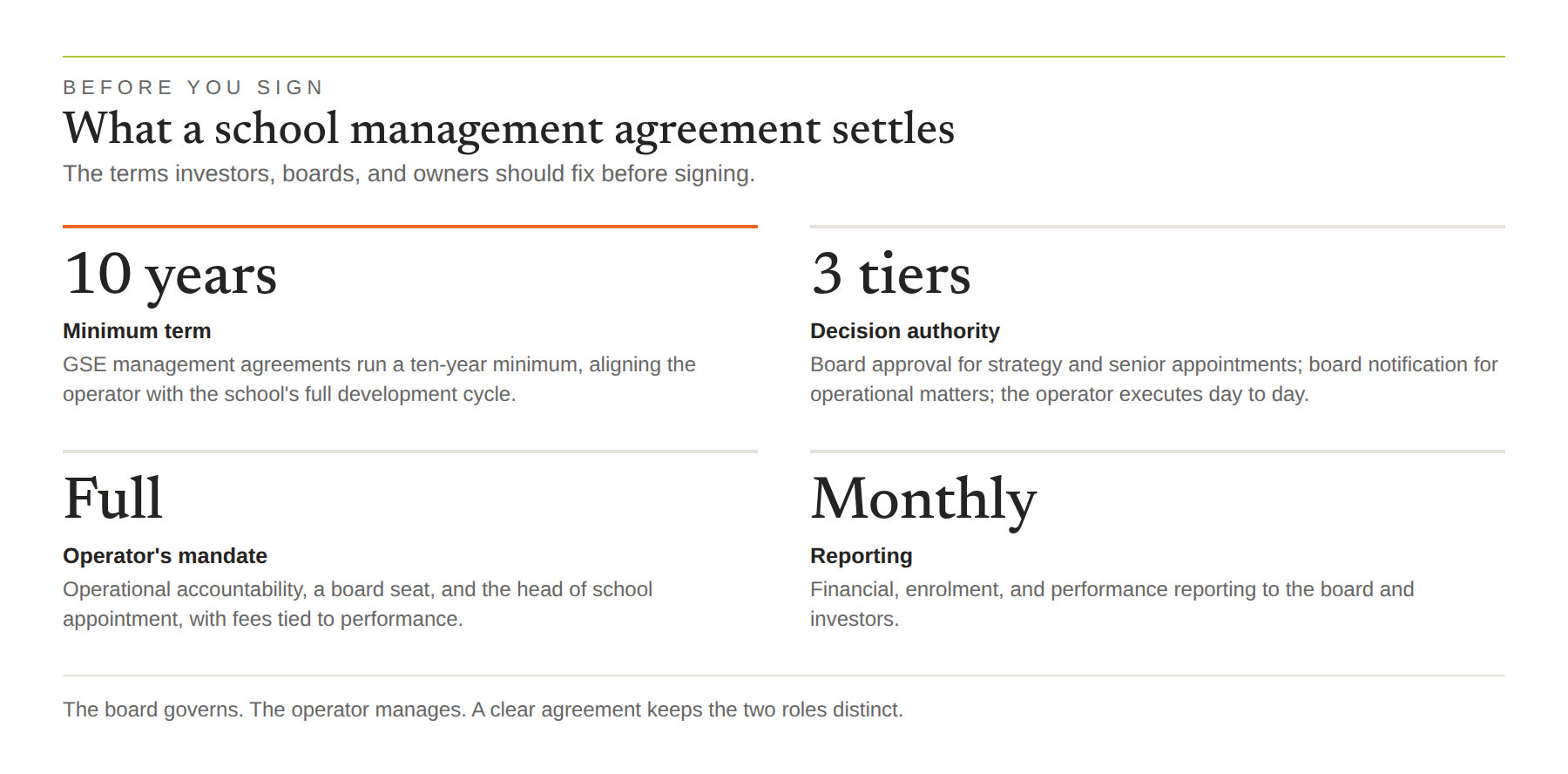
The practical fix is a three-tier decision framework: decisions requiring owner approval, decisions requiring owner notification, and decisions the operator takes independently. Writing that table into the contract removes more disputes than any other single provision.
Why school management is a distinct discipline
High quality management produces high quality results in any industry. That is not in dispute and it is not interesting.
What makes schools difficult is that they need two capabilities which rarely sit in the same organisation. One is educational: curriculum, accreditation, teaching quality, safeguarding, the judgement to know whether a lesson is any good. The other is commercial: enrolment modelling, fee strategy, cost control, capital planning, the discipline to hold a budget when the academic team wants more.
An operator strong on the first runs a well-regarded school that loses money. An operator strong on the second runs a profitable school that families leave. Both fail, on a delay long enough that the cause is usually misattributed.
Both capabilities then have to work in a setting the operator did not grow up in. Most international schools sit in markets where the regulatory system, the labour market, currency conditions and institutional norms differ from the operator’s home country. Visa rules govern who can be hired. Licensing governs what can be taught. Fee increases may require regulatory approval. Land tenure, repatriation of profit and local ownership rules all shape the model before a single student enrols.
This is where domestic experience misleads. Running a good school in the UK, the United States, Canada or Australia builds real expertise, and very little of it covers the part that breaks international projects. The systems are stable, the labour supply is local, and the regulator is predictable. Owners should ask an operator which markets it has actually delivered in, and what went wrong in them.
What the contract must contain
The difference between a contract that protects the owner and one that leaves them exposed comes down to a handful of provisions.
Scope of services. Exactly what the management organisation is responsible for. Vague scope language creates disputes. A well-drafted scope covers academic leadership, curriculum oversight, staffing, financial management, regulatory compliance, marketing and admissions, facilities, and reporting. Anything outside it is the owner’s responsibility unless explicitly added.
Performance indicators. Measurable targets the operator is evaluated against: academic outcomes, enrolment against plan, financial performance against budget, staff retention, regulatory compliance. Indicators without consequences are decorative. The contract must also say what happens when they are missed, including remediation periods and termination triggers.
Reporting. Monthly financial reports, termly academic reports and an annual strategic review are the minimum. Specify format, frequency and recipient. Owners who leave this vague consistently receive less than they need to exercise oversight.
Termination. The circumstances under which either party can exit, the notice required, and the consequences. Termination for cause should carry shorter notice than termination for convenience. Owners who skip this find themselves locked into an arrangement that is not working with no practical exit.
Transition. What happens at the end matters as much as what happens during. The contract should set out how the operator hands over documentation, systems, staff relationships and community relationships.
Intellectual property. Where the operator brings its own curriculum frameworks, systems or brand elements, the contract must say who owns what when the arrangement ends.
Fee structure and what it reveals
Fee levels vary by market, school size and scope, and any figure quoted without that context is decoration. Structure is what matters, and it is visible before a number is agreed.
A fee paid regardless of outcome buys an administrator. The work gets done, reports arrive, and nobody carries the result.
A fee with a performance component buys an operator. The gates are the question worth asking. Enrolment against plan, EBITDA against model, inspection or accreditation outcomes, staff retention. An operator comfortable being paid partly on those expects to hit them. An operator resisting every gate is telling you what it thinks of its own forecast.
The test does not require knowing the market rate. Ask what the operator loses if the school underperforms. If the answer is nothing, the fee structure has already told you who owns the risk.
Why the term length matters
GSE does not sign management agreements for less than ten years. The reason is arithmetic rather than preference.
A new school’s financial model runs to maturity over roughly a decade. Enrolment ramps through the year groups, the fee position settles, the cost base stabilises, and the return arrives late in that curve. A five-year agreement lets the operator hand back the school before the numbers it built have arrived, and lets it report success from a period in which the model was always going to look reasonable.
A term shorter than the model is an operator declining to be measured on the model. Owners should read the length of the agreement as a statement about how long the operator is willing to be held to its own forecast.
Short terms also carry an operational cost. They create leadership instability, discourage investment in people and systems, and signal to families and regulators that the arrangement is provisional.
Governance and the operator’s seat
GSE takes a board seat on the schools it manages. Owners often resist this, reading it as a claim on control.
It works the other way. An operator sitting where decisions are made cannot later attribute failure to decisions it was not party to. It also means the same standard runs across every school under management rather than being renegotiated project by project, which is what integrity means in practice for an operator running more than one school.
The question for an owner is what an operator is avoiding by staying off the board.
Where the contract sits in the wider structure
A management contract is not a franchise agreement, and the two get confused. Under a school franchise model the investor licenses a brand, curriculum framework and operational system, then runs the school within that template. The franchisor’s involvement is largely quality assurance, training and brand compliance. Under a management contract the operator runs the institution itself, appoints the leadership and carries the outcome. Some arrangements blend the two, particularly where an education management organisation brings its own frameworks into a management mandate.
Many management contracts also sit inside a PropCo OpCo structure, where one company owns the land and buildings and another runs the school. The management contract sits at the operating level, which means the operator’s obligations have to be consistent with the operating company’s obligations to the property company. Revenue and cost allocation between the two must be reflected in the fee structure, and exit provisions have to account for both the management contract and the property arrangement. Owners developing under this model should have the management contract reviewed alongside the property documents rather than as a standalone instrument.
Common mistakes
The same errors appear across markets with some regularity.
Aspirational indicators. The contract lists outcomes rather than measurable targets with baselines and timelines. Without those there is no basis for holding anyone accountable and no trigger for intervention.
Weak reporting provisions. The contract requires reports without specifying content or format. The operator meets its obligation with documents that contain little actionable information.
No decision matrix. Authority is left undefined and disputes about it become frequent.
Fees misaligned with incentives. The operator is paid regardless of performance, which removes the commercial reason to deliver outcomes rather than activity.
Insufficient termination protection. Exiting an arrangement that is not working proves difficult or expensive. Owners discover this at the point they most need to act.
No transition plan. When the relationship ends the owner is left without the documentation, systems and institutional knowledge needed to keep operating.
Before you sign
Run proper diligence on the management organisation. Review the track record across comparable schools and markets, speak to current and former clients, and understand the leadership team and operational systems behind the proposal. An operator that cannot demonstrate a performance history in your target market is a risk regardless of how the proposal reads.
Engage legal counsel with education sector experience. General commercial lawyers routinely miss the provisions that matter most here.
Put the governance structure in place before signing. The contract grants the owner rights and the governance framework is how those rights get exercised. Without it, contractual rights prove difficult to enforce.
Align the contract with the wider investment structure. The management arrangement sits inside a capital structure, a regulatory environment and a market context, and all three shape how performance should be measured.
The GSE view
We have walked away from a mandate over a single clause.
The owner wanted financial information held separately from the management function. The reasoning was reasonable on its face. The operator should not have unchecked access to the money.
We agree with that, and our model already answers it. GSE does not sign cheques and does not want to. We oversee procurement, purchasing and staffing, and someone else holds the pen. That separation protects the owner and we would not propose a structure without it.
Oversight without visibility is a different proposition. An operator that cannot see the financial position cannot track performance against the model, cannot catch a cost drift while it is still small, and cannot adjust. It can still be blamed for the outcome. What was being proposed was accountability for a result without access to the information needed to manage towards it.
We declined the mandate.
Owners are entitled to disagree with where we draw that line. What we would say is that the line has to sit somewhere explicit, because a contract that assigns responsibility for performance while restricting sight of the numbers has not allocated risk. It has deferred the argument until the school is underperforming and everyone is looking for somewhere to put it.
Read next
- The 360-Degree School Review, the diagnostic that often precedes a management relationship
- What is an Education Management Organisation
- Governance structures that attract education investors
- 10 Steps to Setting Up a New School
To talk about your school project, reach us through the contact page.