
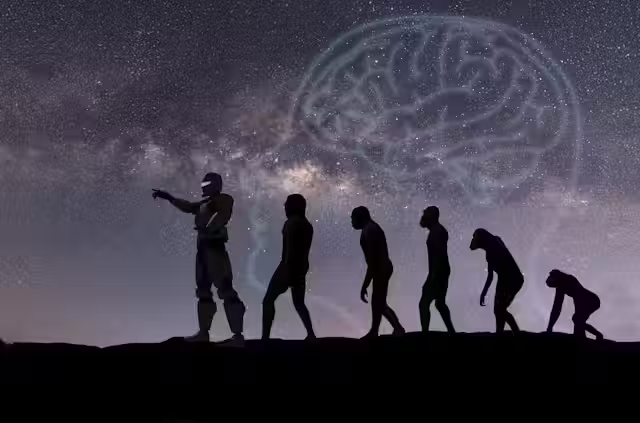
The tribal nature of human beings is live and present today!
At the heart of human behaviour lies a profound inclination towards homophily, the love of the same. This concept describes the natural tendency for people with similar characteristics and beliefs to come together. From a psychological and evolutionary perspective, we are inherently tribal, driven by a subconscious need to distinguish between “us” and “them.” This instinctual behaviour has shaped human interactions for millennia, influencing everything from social circles to cultural and national identities.
The Evolutionary Roots of Tribalism
Our tribal nature can be traced back to the early days of human existence. For over 150,000 years, humans lived in small, close-knit groups. Survival in such environments requires strong social cohesion, trust, and cooperation within the group. Those who were more loyal to their tribe and more suspicious of outsiders had a better chance of surviving and passing their genes to the next generation. As a result, tribalism became ingrained in our DNA, manifesting today in our tendency to form bonds with those who share our values, beliefs, and backgrounds.
This evolutionary trait has had immense survival value. Strong group cohesion enabled early humans to hunt more effectively, protect from predators, and support one another during difficult times. It continues to influence how we form friendships, choose our communities, and build organizations. Whether in hunter-gatherer societies, modern corporations, or nation-states, cohesion among like-minded individuals remains a key factor in facing challenges and achieving collective goals.
The Perils of Overdone Tribalism
However, while tribalism has historically been crucial for survival, it also carries significant downsides, especially in today’s complex and interconnected world. When people only surround themselves with those who agree with them, their views become more extreme and inflexible. This phenomenon, highlighted in Bill Bishop’s work on “The Psychology of the Tribe,” explains how like-minded groups can foster an echo chamber where alternative perspectives are ignored and actively delegitimised.
Such groupthink stifles creativity and innovation, particularly when diverse viewpoints are needed to solve complex problems. For example, a lack of clear structure at the Massachusetts Institute of Technology’s Building 20 led to frequent, unplanned interactions among scientists from different disciplines, fostering unexpected collaborations and groundbreaking innovations. This “Magical Incubator” shows the power of bridging differences rather than deepening divides.
The Modern Manifestations of Being Tribal
In contemporary society, the term “tribe” has evolved beyond its original meaning, now encompassing any social group with a strong identity. Modern tribes form around shared political beliefs, cultural practices, professional identities, and fandoms. This shift reflects a broader social trend where people seek connection and validation in an increasingly fragmented world.
Yet, this modern tribalism also contributes to societal polarisation. Recent events such as political elections, public health debates, and social movements reveal how deeply tribal instincts run, as groups with opposing views often see themselves as the “good guys” fighting against a misguided or malicious “other.” This dynamic, while fostering strong in-group bonds, can also lead to conflict and division.
Humans are, by nature, tribal creatures, drawn to the familiar and the similar. While this instinct has been crucial for survival and social cohesion, it also presents challenges in a world that requires us to navigate and embrace diversity. To move forward, we must recognise our tribal tendencies and actively seek to bridge divides, valuing diverse perspectives as a source of strength rather than a threat.
Applying This Understanding of Tribal in International Schools
Understanding human beings’ tribal nature is particularly relevant in the context of international schools, where diversity is not just a characteristic but a core value. These schools bring together students from various cultural, linguistic, and national backgrounds, creating a unique environment where differences are more visible and potentially more challenging to navigate. In such settings, fostering critical thinking and promoting global thinking are essential strategies for turning this natural human tendency into a strength.
International schools can use their diverse environments to teach students how to engage with people different from themselves, encouraging them to see beyond the superficial markers of identity. By incorporating curricula that emphasize empathy, cultural understanding, and global citizenship, educators can help students break down the “us versus them” mentality. This approach promotes inclusivity and prepares students to think critically about the world around them and appreciate the value of multiple perspectives.
Developing critical thinking skills is vital in challenging the echo chambers that tribal instincts can create. Encouraging students to question assumptions, evaluate evidence, and consider alternative viewpoints helps them avoid the pitfalls of groupthink. By cultivating an environment where diverse opinions are respected and explored, international schools can foster a community of thinkers who are aware of their biases and actively work to overcome them.
Promoting global thinking among young people equips them to navigate an increasingly interconnected world. Understanding different cultures, languages, and perspectives enhances their ability to collaborate across boundaries, making them more adaptable and empathetic global citizens. This kind of education helps students move beyond tribalism’s constraints, embracing diversity as a source of innovation and strength rather than division.
By leveraging the natural desire to form groups, international schools can create learning communities that celebrate diversity while teaching students the importance of unity and mutual respect. In doing so, they prepare young people to be citizens of their own countries and the world, capable of leading with openness, understanding, and a commitment to shared human values.
If you want to learn more about the steps required to set up a school, check out some of our other articles:
– Steps to Setting Up a New School
– 10 Steps and Articles on How to Set Up a New School
– GSE International School Franchise Models
GSE provides specialist services for setting up all education institutions, including international schools, kindergartens, vocational colleges, universities, and online/virtual schools.
About GSE
Global Services in Education plans and opens international schools for investors, developers and governments, and manages them once they are running. GSE has delivered more than 60 school and education projects across 28 countries. Management agreements run a minimum of ten years.
The company was founded in 2011 by Greg Parry and Shanna Parry.