

Almost no school fails accreditation because it is a bad school. Schools fail, or are deferred, because they applied before they had anything to show. The self-study asks for evidence of practice over time, and a school in its second year has opinions rather than evidence.
That makes accreditation a timing decision. The question is not whether to pursue it, or even which body to pursue. It is when the school will have enough history behind it to survive being examined, and whether the regulator will wait that long.
The self-study is an evidence exercise, and evidence cannot be produced retrospectively
Whichever body a school pursues, the process runs the same way. The school examines its own practice against the body’s standards, then an external visiting team spends several days on campus observing lessons and interviewing students, staff, parents and governors. The self-study alone typically takes twelve to eighteen months to complete properly.
CIS, WASC and Cognia all require substantial evidence of educational practice, governance, student outcomes, staff qualifications and improvement planning. That is the part schools underestimate. None of it can be assembled in the months before a visit. A school that has not been tracking student outcomes has no outcomes data. A school whose board has met irregularly and minuted little has no governance record. The governance framework established before opening is what produces the evidence base years later.
So the self-study does not test how good the school is on the day the team arrives. It tests whether the school has been run properly for long enough to prove it.
The bodies themselves set a floor, and it is measured in years
CIS requires a school to have been operating for at least two full academic years before it can begin the accreditation process. That is a floor rather than a target. Beginning at the earliest permitted moment means submitting the thinnest evidence a school will ever have.
The processes are long once started. CIS runs two to four years from membership to award. WASC runs two to three. Cognia is faster at eighteen to twenty-four months, COBIS twelve to eighteen, and ASIC six to twelve. IB authorisation runs two to three years for each programme, so a school authorising at primary, middle and diploma level is committing to a sequence rather than an event.
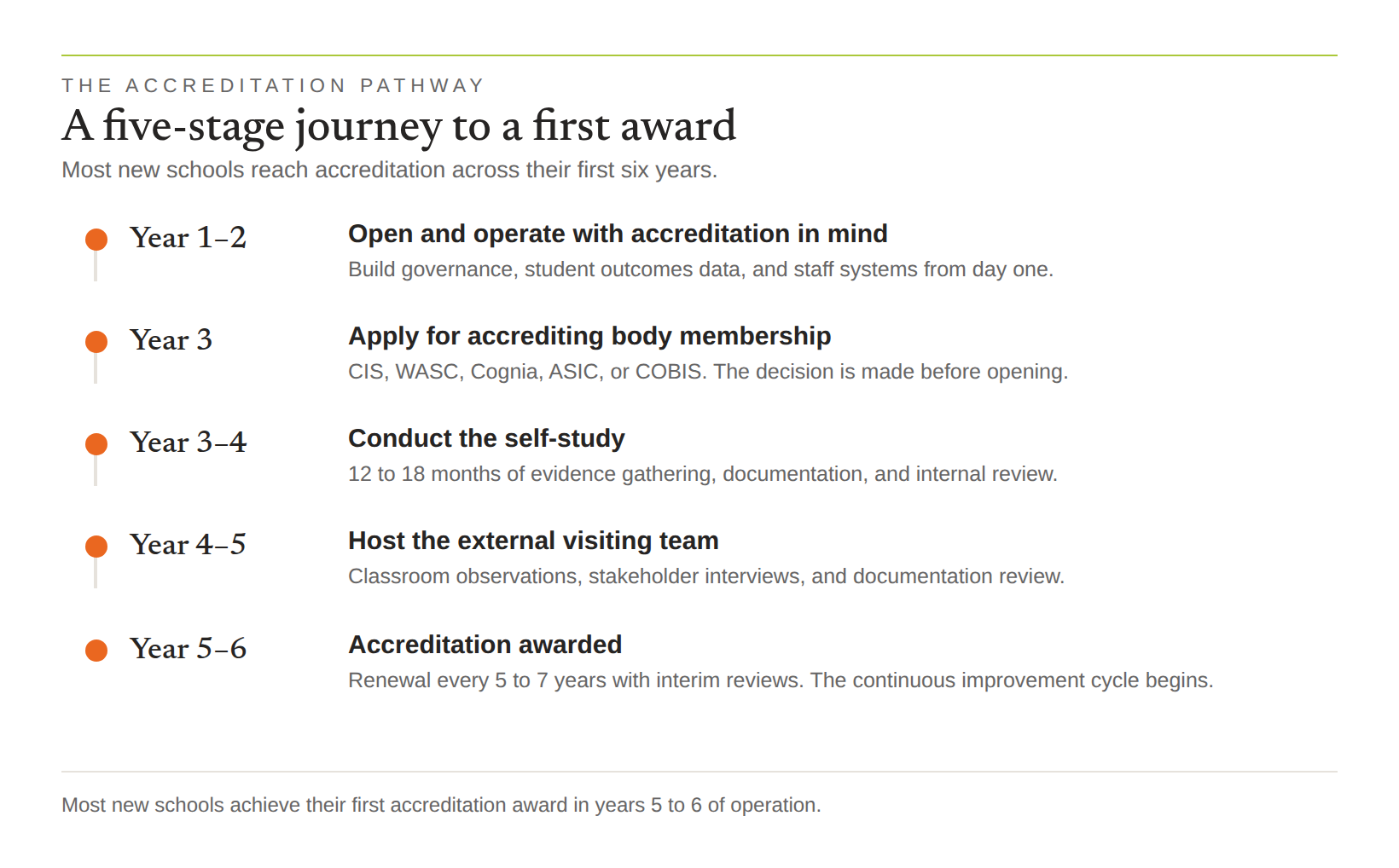
Read those figures forward from opening day rather than from the day someone decides to apply. A school that opens in September, waits the required two years, then runs a four-year CIS process, is in its seventh year before it holds an award.
In regulated markets the calendar is not the school’s to set
Voluntary accreditation is one thing. Regulatory inspection is another, and it does not wait for readiness. In Dubai a school’s first full inspection lands automatically in its third year, and the band it receives governs what it may charge, as set out in Dubai’s school inspections restart, and the rating is the revenue line.
That inverts the usual advice. A school in a regulated market cannot decide to wait until it is ready, because the assessment arrives in year three whatever it does. The only variable it controls is what condition it is in when the inspectors come, and the outcome is priced into the fee schedule rather than into a certificate on the wall.
What going too early actually costs
A deferral is not a neutral outcome that can be quietly retried. It sets the school back two to three years, it signals weakness to a parent community that is already comparing the school against established competitors nearby, and it removes one of the few defensible advantages a new school can build.
The direct costs are the smaller half. Membership and assessment fees range from several thousand to tens of thousands of dollars across a full process, alongside dedicated staff time and, in some cases, facility work to meet standards. The larger cost is the years. A school that applies too early and is deferred has spent the same money and arrives at an award later than a school that waited.
This belongs in the five-year plan as a funded milestone with a date, not as something to address once the school is profitable. It also belongs in the model, because a school holding a credible award inside its first five years is a materially different asset at valuation from one that treats accreditation as an aspiration.
Choosing the body is itself a timing decision
The bodies differ by more than prestige. They differ by years, and the choice therefore sets the calendar. The right pathway depends on curriculum, target market and positioning rather than on which name carries most weight in the abstract.
A British curriculum school serving expatriate families in the GCC gets more from COBIS membership and ASIC accreditation than from a US-oriented process. A school competing at the premium IB end of the Dubai market should prioritise IB authorisation, because that is what those families are comparing. A school serving a mixed international community with university placement across several countries is a CIS school, potentially through the joint pathway CIS operates with WASC and the IB, which allows one integrated process to satisfy several bodies at once.
| Body | Typical Process Length | Best Fit For | Recognition Strength |
|---|---|---|---|
| CIS | 2 to 4 years | Mixed international communities, premium positioning | Strongest global recognition |
| WASC | 2 to 3 years | Schools with US university placement focus, often paired with CIS or IB | Strong with US universities and globally |
| Cognia | 18 to 24 months | American curriculum schools, US-linked communities | Strong in the US system, widely used internationally |
| ASIC | 6 to 12 months | British curriculum schools, newer schools seeking initial credibility | UK-recognised, lighter recognition outside Britain |
| COBIS | 12 to 18 months | British curriculum schools serving expatriate communities | Strong with British families and UK universities |
| IB Authorisation | 2 to 3 years per programme | Schools positioning at the premium IB end of their market | One of the strongest signals of educational quality |
The decision has to be made before the school opens rather than after, because it shapes curriculum design, governance structure, staff hiring and facility specification. Choosing late means retrofitting, which is the expensive version of every decision in this article.
What to do in the years nobody is watching
The work that produces a clean pass happens long before the visiting team is booked. Operate to the standards of the intended body from day one, even though the formal process is years away. Track student outcomes from the first cohort. Minute the board properly. Keep the improvement plan as a live document rather than a file produced for the visit.
Then apply when the evidence exists, not when the floor allows it. The gap between those two dates is the whole decision, and it is the one an owner controls.
Accreditation planning sits alongside the financial model rather than after it, which is why it belongs in the feasibility study and in the school development process rather than in a later phase.
Read next
- Dubai’s School Inspections Restart, and the Rating Is the Revenue Line. What happens when the assessment calendar belongs to the regulator.
- Governance Structures That Attract Education Investors. The framework that produces the evidence a self-study needs.
- The School Feasibility Study. Where the accreditation pathway is first costed and dated.
- How to Value an International School. How the award translates into the figure at exit.

To talk about your school project, reach us through the contact page.