
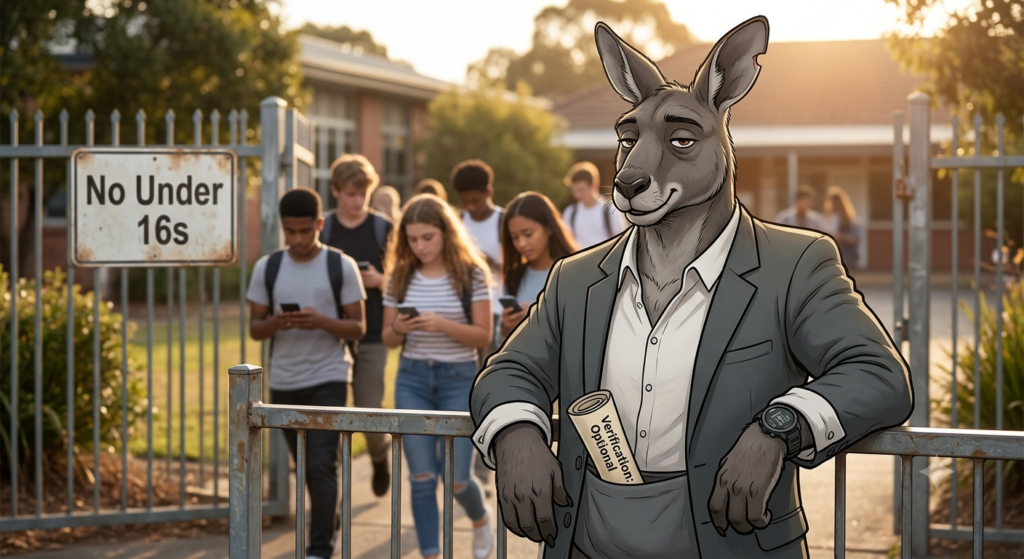
“A first, this. I usually keep myself to a line or two on a Friday, delivered from the back of whatever boardroom will have me. This one needed more room. Three decades building schools and the businesses behind them leaves a kangaroo with opinions on most things and patience for very few. Australia’s social media ban is this week’s.“
Clancy
By Clancy.
Walk into a Year 9 classroom anywhere in Australia this week, six months into the social media ban, and you will find a room full of teenagers who, officially, no longer exist online.
They have been removed. Restricted. Aged out. The accounts are gone.
And yet the group chat still hums through every lesson, the lunchtime drama still arrives fully formed, and the kid in the back row already knows exactly what happened on TikTok last night.
Funny, that.
Since December, platforms have been required to take reasonable steps to keep under-sixteens off social media. Millions of accounts vanished. Ministers stood in front of cameras. Other countries took notes.
Then someone thought to ask the teenagers what had actually changed.
Not much, as it turns out. Early research suggests more than four in five under-sixteens are still online months later. They changed a birth date. Borrowed an identity. Opened a fresh account under a name their own grandmother would not recognise. They treated the verification screen the way they treat a locked door at a party. As a suggestion.
I have watched a fair few education systems try to legislate teenage behaviour. It rarely ends with the teenager surrendering.
The problem is real, and pretending otherwise helps no one
Let me get one thing out of the way before the comments fill up.
The ban exists for good reason.
These platforms are not friendly noticeboards that children happen to wander past. They are commercial machines built to hold attention, study behaviour and keep a user scrolling long after the user wanted to stop. Children walk into that machinery while their judgement is still under construction.
The harm is not imaginary. Bullying that follows a child home and sits up all night. Exploitation. Body-image pressure dressed up as inspiration. Content that finds the exact thing a struggling teenager should never see, then serves it again tomorrow.
Teachers see the fallout every Monday morning. Parents are not inventing it. The case for doing something is real.
So this is not an argument against acting. It is an argument about whether a ban, on its own, does the thing everyone hoped it would.
A ban delays the door. It does not teach the child to walk through it.
Here is the part that gets lost the moment this turns into a shouting match about whether the ban worked.
An account is not a child.
You can delete a million accounts and report a triumphant number. One teenager can lose three accounts and open a fourth before dinner. The number looks spectacular. The behaviour barely moves.
But the deeper problem is the one an educator notices first.
A ban controls access. It does nothing about judgement.
Picture the child this policy is meant to protect. She turns sixteen. The gate opens. She walks into the full, unfiltered marketplace having learned precisely one digital skill in all the years she was kept out. How to lie to a verification box.
She has not learned to spot manipulation. To guard her own information. To notice when an algorithm is steering her somewhere she did not choose to go. To handle cruelty that arrives at midnight with an audience.
We will have spent years guarding the gate and taught her nothing about the road on the other side of it.
That is the education problem hiding inside the policy problem. You cannot download judgement on a sixteenth birthday. It has to be built, slowly, in the very years we are currently spending pretending the child is not online at all.
The companies suddenly cannot tell how old you are
Let us not let the platforms tiptoe out the back while everyone argues about teenagers.
These are companies that know you paused on a holiday advert last week, that your knee has been bothering you, and that you have been quietly comparing mattress prices at two in the morning. They can model your mood, your habits and the precise moment you are most likely to keep scrolling.
Ask them to work out whether an account belongs to a fourteen-year-old posting from a school uniform, and the technology turns mysterious. The cleverest data operation in human history, and somehow it cannot count to sixteen.
The law puts the duty on the platforms. Good. That is where it belongs. They built the machine, they profit from the machine, they can build one that survives a teenager testing it.
And there is far more they could be made to do than guard the front door. Slow the notifications for minors. Kill the autoplay. Turn off the endless scroll. Stop amplifying the content doing the damage. Open the recommendation systems to independent researchers instead of issuing another warm statement about community standards from a building with a meditation room.
That is harder than announcing a number. It also goes after the product rather than the child trying to reach it.
The phone did not arrive by weather event
There is a strange version of this debate where children, platforms and government are the only people in the room, and the phone simply materialised in the house one night during a storm.
Someone bought it. Someone pays the bill. Someone decides whether it comes into the bedroom at night.
This is not about blaming tired parents. The platforms hold every advantage. They employ behavioural scientists. The parent is trying to cook dinner and stop the household turning into a small riot.
But the ban is backup, not a substitute. A national rule is genuinely useful. It lets a parent stop being the only villain in the suburb who said no to Snapchat and point at something bigger instead.
What it cannot do is sit by the bed at midnight. It cannot put the phone on top of the fridge. It cannot supply the willingness to be unpopular with your own child for longer than seven minutes. A law can give a parent backup. It cannot give them a backbone.
Why the social media ban lands back on schools
And before the whole thing gets handballed to the classroom, a word from my side of the fence.
Schools cannot be the place society sends every problem it would rather not solve at home or in parliament. Teachers are already nutrition coach, counsellor, referee and parent of last resort.
But digital judgement is one thing schools genuinely can build, if we treat it as a real subject rather than an assembly once a term. Not a lecture about stranger danger. The actual skill of reading a feed, questioning a source, noticing the pull of an algorithm and managing your own attention.
That is the work the ban quietly assumes someone else is already doing. Right now, mostly, no one is.
So what would actually help
Protecting children online was never going to fit on a press release.
Government has to set real rules, enforce them, then be honest about what the evidence shows rather than treating deleted accounts as a scoreboard.
Platforms have to stop treating children as a high-value audience with the unfortunate public-relations habit of being children.
Parents have to hold the line, and accept that good parenting sometimes sounds like a slammed bedroom door.
Schools have to build judgement, not just police behaviour.
And children have to be let into the digital world the way we let them into the real one. Gradually, with guidance. Not released at sixteen like a mob through an open gate.
The ban can be part of that. It might delay the first account. It might force the platforms to lift their game. It might help a parent hold a line they were struggling to hold alone.
But if its single great achievement is teaching a generation of teenagers to lie more convincingly to a screen, we have not protected childhood.
We have just moved it behind a better fake name.
Catch me if you can
Australia put up a fence and the kids found the gap before the first bell. That does not make the fence pointless. It makes it a start, not the finish line everyone seemed to think they had already crossed.
The real work is slower and far less satisfying to announce. Safer products. Honest enforcement. Parents who can outlast a sulk. Schools that teach judgement instead of just confiscating phones. Children who learn to handle the road before we swing open the gate.
Until then, somewhere in the suburbs, a fourteen-year-old whose new account lists him as a thirty-one-year-old electrician is scrolling away under the covers. Untroubled. Unbothered. Entirely undefeated.
For now, he is winning.
Something from the pouch.
Clancy is the resident voice of Global Services in Education.
Created and written by Greg Parry.
Further reading
The six-month results and the policy response, across the spectrum of coverage:
- Australia toughens kids’ social media ban, doubles potential penalties (Reuters, via CNBC). The latest move: fines lifted to A$99m and stronger powers for the eSafety Commissioner.
- 85% of kids are still using social media despite the ban, but we need a new measure to judge its success (The Conversation). The researchers behind the BMJ study on why early usage numbers may be the wrong test.
- Australia’s teen social media ban works on paper, less so in practice (The Next Web). A clear read on the gap between the rule and the result.
- More than 60% of Australian children still using social media despite the ban (Molly Rose Foundation). The child-safety case that platforms, not children, are the failure point.
Related Articles
Read more in our International School Business and Leadership Articles hub.
📩 Contact GSE Directly Contact Link
GSE’s Comprehensive School and University Development Services
GSE offers end-to-end solutions tailored for new and existing schools, covering:
School Management & Operations
Strategic Planning & Feasibility Studies, including Financial modelling
Architectural & Interior Conceptual Design
School Resources & ICT Planning
Marketing, Branding & Admissions
Staffing, Recruitment & Training
Curriculum Design & Accreditation Support
School Audits & Action Plans
Let’s Build a World-Class School Together!
Ready to start or improve your school?
Visit www.gsineducation.com
Recent Comments