



How to Get International School Accreditation
Accreditation is one of the most misunderstood aspects of international school development. Investors ask about it early in the planning process, often because they have heard it matters for enrolment and reputation. School leaders ask about it too, usually after opening, when parents start comparing them to established schools nearby. The honest answer is that accreditation does matter, but what it means, when to pursue it, and how to approach it successfully depends entirely on which body you are seeking accreditation from, which market you are operating in, and how operationally ready your school genuinely is. The school feasibility study is the stage at which the accreditation strategy should first be addressed.
This article explains the accreditation landscape for international schools, what the major bodies actually assess, how long the process takes, and what school operators and investors need to understand before committing to a pathway.
Why Accreditation Matters
Accreditation is an independent verification that a school meets a defined standard of educational quality. In the international school context it serves three distinct audiences.
For parents, accreditation signals that an external body has examined the school and found it credible. In competitive markets like Dubai, Singapore, and the GCC, parents actively research accreditation status before shortlisting schools. A school without any accreditation pathway, particularly one competing against KHDA-rated, CIS-accredited, or IB-authorised schools, faces a reputational disadvantage that is difficult to overcome through marketing alone.
For universities, accreditation provides assurance that a school’s academic programme meets a recognised standard. This matters most in the secondary years, where students are applying to competitive universities internationally. A school whose graduates cannot demonstrate they attended an accredited institution will lose enrolment at the senior secondary level as families migrate to schools with stronger university placement records.
For investors and boards, accreditation provides a framework for governance and continuous improvement that has a direct bearing on school value. A CIS-accredited school commands a materially higher valuation multiple than an unaccredited school of similar size and revenue, because accreditation reduces risk in the eyes of acquirers and institutional investors. This is explored further in our article on school governance structures that attract education investors.
The Major Accreditation Bodies
There are dozens of bodies offering international school accreditation, ranging from globally recognised organisations with rigorous multi-year processes to lesser-known bodies whose standards and recognition are limited. Understanding the difference matters.
CIS (Council of International Schools) is the most widely recognised accreditation body in the international school sector. With over 715 member schools engaged in its accreditation programme, CIS accreditation carries genuine weight with universities, governments, and parent communities globally. The process is comprehensive, typically spanning two to four years from initial membership to accreditation award. It assesses the school across three dimensions: Purpose, Practices, and Planning, with a focus on the school’s impact on student learning and wellbeing, its governance and leadership, and its capacity for continuous improvement. CIS requires schools to have been operating for at least two full academic years before beginning the accreditation process.
WASC (Western Association of Schools and Colleges / ACS WASC) is an American regional accreditor with a strong international presence, particularly in Asia, the Pacific, the Middle East, and Africa. WASC accreditation involves a self-study process followed by a visiting committee review. It is well recognised by US universities and by a broad range of international higher education institutions. WASC has a formal joint accreditation pathway with CIS and the IB, which allows schools to complete a single integrated process that satisfies the requirements of multiple bodies simultaneously.
Cognia (formerly AdvancED) accredits over 30,000 schools in more than 70 countries and is the accrediting body for US Department of Defense schools internationally. Its process focuses on continuous improvement and is widely recognised for US curriculum schools operating internationally.
ASIC (Accreditation Service for International Schools, Colleges and Universities) is a UK government-approved independent accreditor that benchmarks schools against UK quality standards. It is commonly pursued by British curriculum schools operating internationally and is recognised by UK Visas and Immigration. The process is less intensive than CIS or WASC and can be completed more quickly, making it a practical entry-level accreditation for newer schools.
COBIS (Council of British International Schools) is a membership association for British international schools of verified quality. COBIS accreditation involves a monitoring visit and is specifically oriented toward schools operating within the British educational tradition. It is well recognised in the British expatriate community and by UK universities.
IB (International Baccalaureate) Authorisation is technically a curriculum authorisation rather than a school-wide accreditation, but in practice it functions as both. Becoming an IB World School, whether for the Primary Years Programme, Middle Years Programme, or Diploma Programme, requires a rigorous authorisation process that assesses the school’s capacity to deliver the programme with fidelity. IB authorisation is one of the most powerful signals of educational quality in the international school market and significantly affects both enrolment and fee positioning.
What the Process Actually Involves
Regardless of which body a school pursues, the accreditation process follows a broadly similar structure.
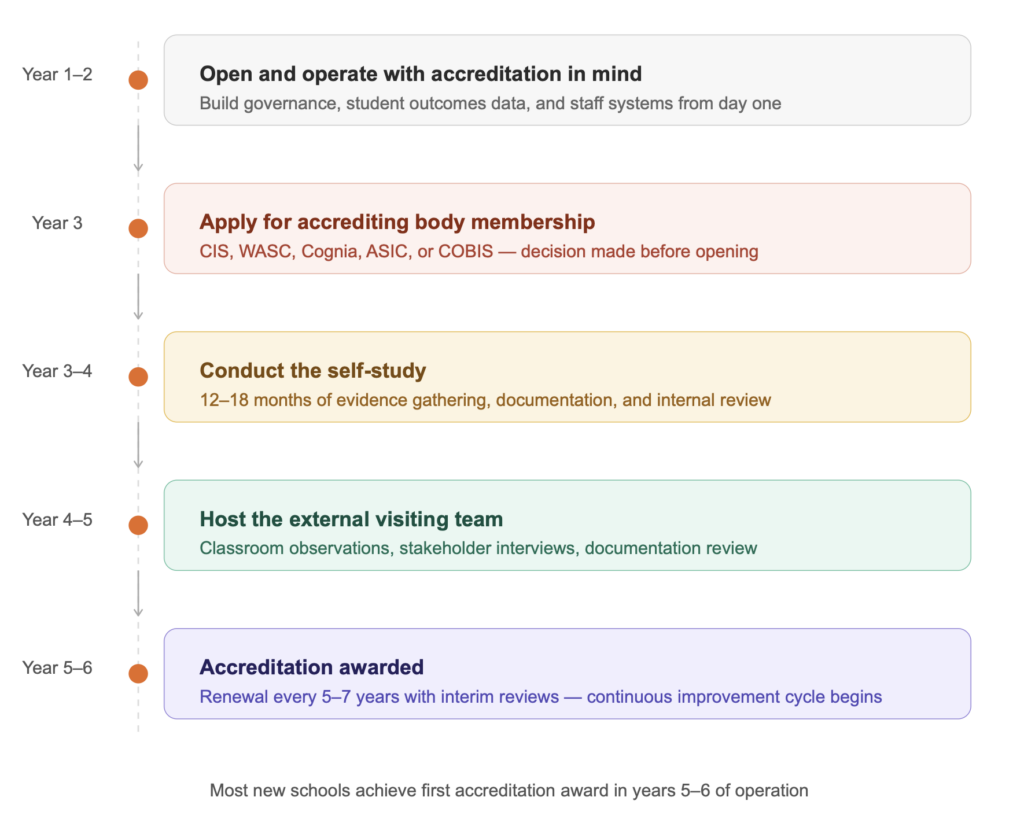
The school begins with a period of self-study, examining its own practice against the accrediting body’s standards. This is not a superficial exercise. CIS, WASC, and Cognia all require schools to produce substantial evidence of their educational practice, governance structures, student outcomes, staff qualifications, and improvement planning. The self-study typically takes twelve to eighteen months to complete properly.
The governance framework a school establishes before opening has a direct bearing on how well it performs during the CIS self-study. A well-structured school board and management accountability framework produces the evidence base that accreditation bodies look for.
Following the self-study, an external visiting team spends several days on campus. The visit involves classroom observations, interviews with students, staff, parents, and board members, and a review of the school’s documentation and physical environment. The visiting team produces a report that identifies areas of strength and areas requiring development.
The accrediting body then makes a decision, which may be full accreditation, accreditation with conditions, or deferral pending improvement in specific areas. Accreditation is not permanent. It requires renewal on a cycle of typically five to seven years, with interim progress reviews in between.
When to Start the Process
The timing question is where many schools make strategic errors. The most common mistake is pursuing accreditation too early, before the school has the operational maturity, student outcomes data, and evidence base to support a credible self-study. Submitting for CIS accreditation after one year of operation, before the school has any meaningful student achievement data or established community, wastes resources and risks a poor outcome that sets back the school’s credibility rather than advancing it.
The practical guidance is to plan for accreditation from day one, operate with accreditation standards in mind from the moment the school opens, and formally begin the process once the school has completed at least two full academic years and has sufficient evidence of its educational practice. For most new international schools, this means the accreditation process begins in years three to four of operation, with the first formal accreditation award targeted for years five to six.
This timeline should be communicated clearly to the board and to investors at the outset. Presenting accreditation as a year-one objective is unrealistic and creates pressure to rush a process that demands genuine institutional evidence.
Accreditation and the Investment Case
From an investor’s perspective, accreditation belongs in the school’s five-year strategic plan as a defined milestone with a budget allocation, not as an aspiration to be addressed when the school is profitable. The accreditation process requires dedicated staff time, external consultant support in some cases, potential facility improvements to meet standards, and the direct costs of membership and assessment fees, which vary by body but typically range from several thousand to tens of thousands of dollars across the full process.
A school that plans for accreditation properly, builds the operational infrastructure to support it from the outset, and achieves a credible accreditation award within its first five years will be a materially more valuable asset than one that treats accreditation as an afterthought. Understanding how accreditation planning connects to the broader financial model is part of what GSE covers in its school development process. The PropCo/OpCo structure a project adopts also affects which entity is responsible for accreditation costs and obligations. The fee premium that accredited schools can command, the enrolment advantage in competitive markets, and the exit multiple that accreditation supports all justify the investment.
Choosing the Right Body
Not every school needs CIS accreditation, and not every school should pursue IB authorisation. The right accreditation pathway depends on the school’s curriculum, its target market, and its strategic positioning.
A British curriculum school serving a primarily British expatriate community in the GCC will benefit more from COBIS membership and ASIC accreditation than from a US-oriented process. An IB school competing at the premium end of the Dubai market should prioritise IB authorisation above all else, as that is what the parent community in that segment values. A school serving a mixed international community in Southeast Asia with aspirations for university placement in multiple countries should target CIS as its primary body, potentially in conjunction with WASC through the joint pathway.
The decision should be made before the school opens, not after, because the choice of accreditation body influences curriculum design, governance structures, staff hiring priorities, and the school’s self-study preparation from day one. This is one of the reasons why how to start a school business addresses accreditation strategy as part of the ownership and operational model decisions, not as a separate post-opening consideration.
Working With a Partner Who Has Done It Before
The accreditation process is demanding, time-consuming, and consequential. Schools that approach it without experienced guidance frequently underestimate the preparation required, produce self-study documentation that does not meet the standard, and either receive a deferred outcome or spend years in a remediation cycle that could have been avoided.
GSE has guided schools through accreditation processes across multiple bodies and multiple markets. That experience spans the preparation phase, the self-study, the visiting team process, and the post-accreditation improvement cycle. For investors and school operators planning a new school or seeking to strengthen an existing one, integrating accreditation planning into the broader school development and management strategy from the outset is the most efficient path to a successful outcome. Contact GSE to discuss your accreditation pathway.
Related Articles
- How to Start a School Business
- What is a School Management Contract?
- School Governance Structures That Attract Education Investors
- How to Conduct a Feasibility Study for a New School
- Why Most New School Projects Fail Financially
- International School Accreditation — 10 Steps Series
- International School Development
- Contact GSE
There must be a clear strategy and plan to make a school project investment ready: Learn more
👉 [10 Steps to Setting Up a New School]

Meet Our CEO & Education Expert
Greg Parry – International School Leadership Authority
Greg Parry is an international education investor and leadership consultant. He is the Co-Founder and CEO of Global Services in Education and GSE Capital Advisory Group, advising on school development, management, and education-focused investment worldwide. His work bridges leadership theory and practical transformation across more than thirty-five countries.
Greg Parry is a renowned global expert in education leadership, having led projects in Australia, the Middle East, the United States, India, Indonesia, Malaysia, and China. His accolades include:
🏆 Minister’s Award for Excellence in School Leadership
🏆 School of Excellence Award for Industry/School Partnerships
🏆 School of Excellence Award for Technology Innovation
🏆 Recognised for Best Global Brand in International Education (2015 & 2016)
With a strong track record in school start-up projects, leadership training, and curriculum development, Greg is a trusted authority in building and managing high-performing international schools.
📩 Contact Greg Parry Directly [Contact Link]
GSE’s Comprehensive School and University Development Services
GSE offers end-to-end solutions tailored for new and existing schools, covering:
✔ School Management & Operations
✔ Strategic Planning & Feasibility Studies, including Financial modelling
✔ Architectural & Interior Conceptual Design
✔ School Resources & ICT Planning
✔ Marketing, Branding & Admissions
✔ Staffing, Recruitment & Training
✔ Curriculum Design & Accreditation Support
✔ School Audits & Action Plans
Let’s Build a World-Class School Together!
💡 Ready to start or improve your school?
Visit www.gsinedu
Recent Comments