

Governance Structures That Attract Education Investors
Governance is the aspect of school development that investors talk about the least and worry about the most. It rarely features prominently in feasibility studies or investor presentations. It is treated as something to sort out later, once the capital is committed and the school is taking shape. That sequencing is one of the most consistent and costly mistakes in private education investment.
Investors who have evaluated multiple school projects will tell you the same thing. The financial model matters. The location matters. The curriculum and the leadership team matter. But governance is the variable that determines whether all of those elements hold together under pressure. A school with strong governance can survive a difficult year, a leadership transition, or an unexpected regulatory challenge. A school with weak governance struggles to survive its own success.
What Governance Means in a School Context
Governance in a school investment context is not the same as governance in a purely corporate context, though the principles overlap significantly. School governance covers the structures, processes, and relationships through which strategic decisions are made, performance is monitored, accountability is maintained, and the interests of different stakeholders, including investors, owners, operators, staff, families, and regulators, are balanced.
In practical terms, governance answers several questions that every serious investor needs answered before committing capital. Who has the authority to make which decisions? How is the management team held accountable for outcomes? What happens when performance falls short of projections? How are conflicts between investors, operators, and the board resolved? What are the exit provisions and how are they enforced?
Projects that cannot answer these questions clearly at the outset will struggle to answer them under pressure. Governance design is not bureaucracy. It is the architecture that makes accountability possible.
Why Governance Signals Risk to Investors
When an experienced investor evaluates a school project, governance quality is one of the first things they assess, even if they do not always use that word. They are looking for evidence that the people running the project have thought carefully about how decisions will be made, how performance will be monitored, and how problems will be escalated and resolved.
Weak governance signals several risks simultaneously. It suggests that key decisions may be made informally, without proper documentation or accountability. It raises the possibility that the boundary between owner interests and operational management has not been clearly defined, creating conditions for either interference or neglect. It implies that the reporting structures needed to maintain investor oversight have not been designed, which means investors will receive less information than they need to manage their exposure.
Strong governance signals the opposite. It tells investors that the project has been designed with institutional discipline, that the management team operates within a defined accountability framework, and that there are mechanisms in place to surface problems early rather than allow them to compound. For investors accustomed to the transparency standards of institutional real estate or private equity, a school project without credible governance structures simply does not compete.
The Ownership Structure and What It Must Clarify
Governance begins with ownership clarity. Before any board is constituted or any management framework is designed, the ownership structure must answer four questions without ambiguity.
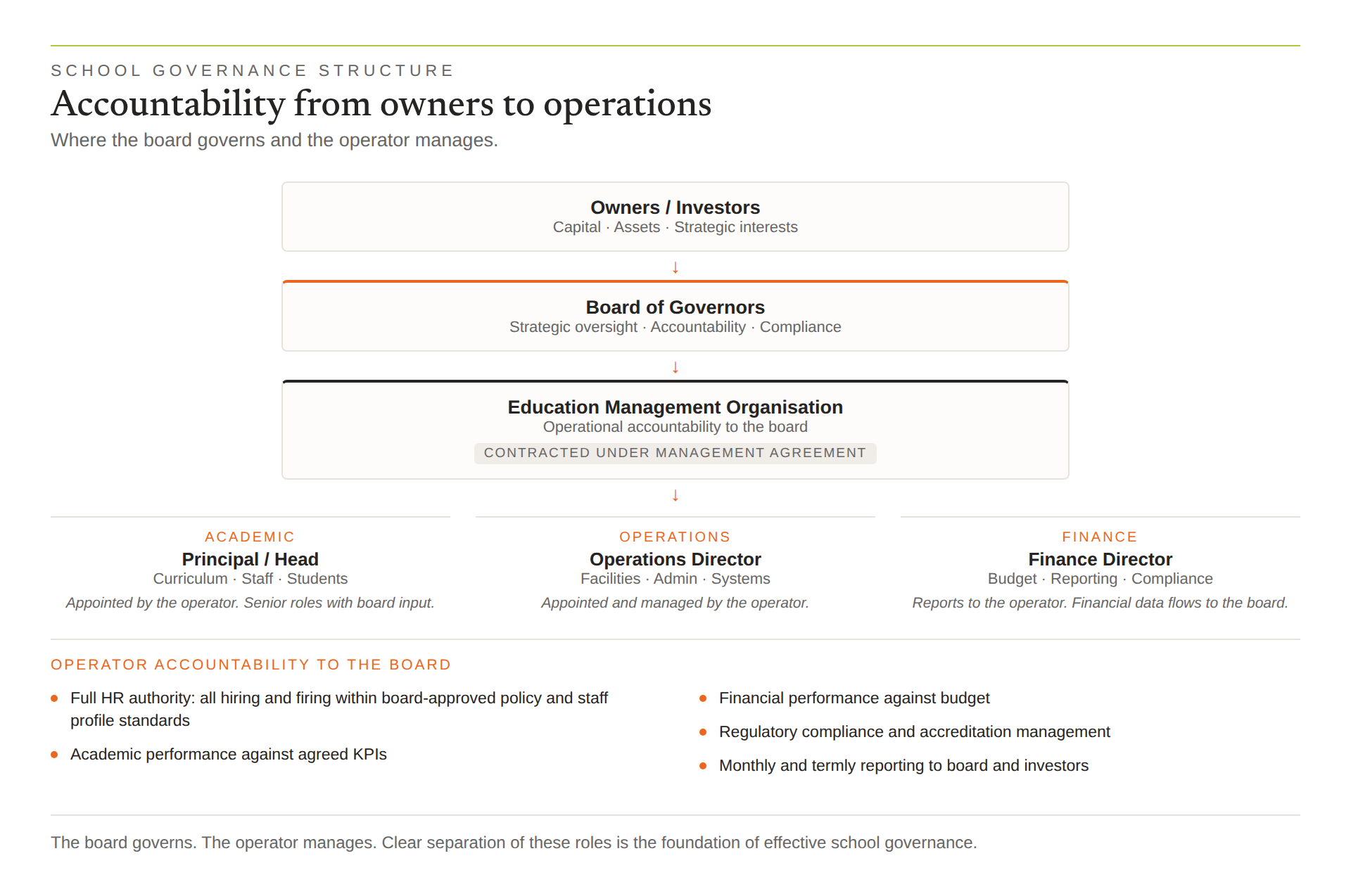
Who owns the assets? In a PropCo/OpCo structure, the answer is divided between the property company and the operating company. In a single-entity structure, one company owns both. Either can work, but the governance framework must reflect which structure is in place and ensure that accountability for assets and operations sits in the right place.
Who controls operational decisions? Asset ownership and operational control do not always sit with the same party, particularly where an Education Management Organisation has been engaged to run the school under a management contract. The governance framework must define the boundary between owner oversight and operational authority clearly enough that neither party is in doubt about where their responsibilities begin and end.
How are financial returns distributed? This should be documented in founding agreements and reflected in the governance framework. Disputes over financial distribution are among the most common causes of governance breakdown in school projects and are almost always attributable to inadequate documentation at the outset.
What exit options exist? Exit provisions belong in the governance framework, not as an afterthought once the investment is performing. Investors need to know how they can exit, under what conditions, at what valuation methodology, and with what notice period. Projects that cannot answer this question credibly will struggle to attract institutional capital.
The Board: Structure, Composition, and Responsibilities
The board is the primary governance mechanism in most school investment structures. Its quality, composition, and clarity of mandate are among the most important factors an investor will assess.
An effective school board is not a committee of enthusiasts. It is a structured body with defined responsibilities, appropriate expertise, clear accountability to the school’s owners, and the professional independence to exercise genuine oversight of the management team.
The board’s core responsibilities are strategic direction, financial oversight, leadership evaluation, risk management, and regulatory compliance. It does not manage daily operations. It does not approve routine staffing decisions or get involved in classroom practice. Its role is to set the direction, hold the leadership team accountable for delivering it, and ensure that the interests of owners, investors, and the school community are properly balanced.
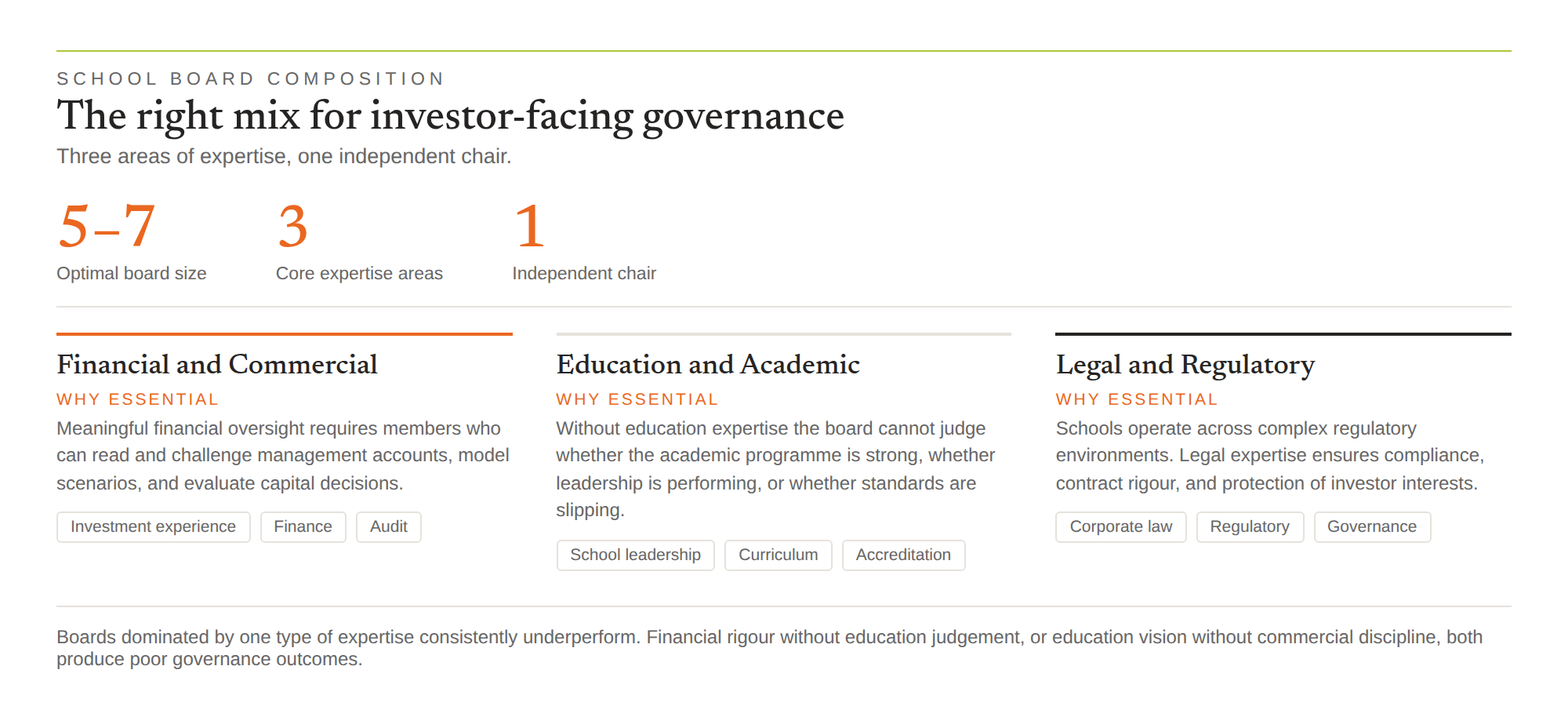
Board composition matters considerably. A board dominated by people with no commercial or financial experience will struggle to exercise meaningful oversight of a school’s financial performance. A board with no educational expertise will struggle to evaluate whether the academic programme is genuinely strong or whether leadership is performing to the right standard. The most effective boards combine financial and commercial capability with genuine education sector experience, complemented by relevant professional backgrounds such as legal, regulatory, or community expertise.
Board size should be practical. A board of five to seven members is typically the right range for a single-school investment. Larger boards create slower decision-making and diluted accountability. Smaller boards risk insufficient diversity of expertise and inadequate challenge to management.
Separating Governance from Management
The most common governance failure in school development is the collapse of the boundary between board oversight and management execution. It manifests in two ways, both damaging.
The first is excessive board involvement in operational decisions. Board members who become involved in staffing decisions, curriculum choices, or daily operational matters undermine the authority of the management team and create confusion about accountability. If the management team is not trusted to manage, the solution is to replace them, not to govern around them.
The second is insufficient board engagement with strategic and financial performance. Boards that meet infrequently, receive inadequate reporting, and defer consistently to management without challenge are not exercising governance. They are providing cover. When performance deteriorates, a disengaged board is rarely positioned to intervene effectively because they have not maintained the information flow and institutional relationships needed to understand what has gone wrong.
The solution is a clearly documented decision framework, the same three-tier model discussed in the context of school management contracts: decisions that require board approval, decisions that require board notification, and decisions that management can take independently. Once that framework is documented and understood by both the board and the management team, the relationship functions more effectively and accountability is easier to maintain.
In GSE-managed schools, this boundary is contractual. GSE holds a board seat and leads the appointment of the Head of School, with the structure of the final decision agreed with each board. Accountability for performance stays attached to the party responsible for delivering it.
Reporting and Transparency
Governance without information is governance in name only. The reporting framework is the mechanism through which the board and investors maintain visibility over the school’s performance.
At a minimum, the reporting framework should deliver monthly financial reporting against budget, termly academic performance data covering enrolment, retention, results, and accreditation status, and an annual strategic review that assesses progress against the school’s long-term plan. Each report should be in a consistent format that allows trend analysis over time rather than one-off snapshots.
Investors should expect and require reporting that goes beyond financial data. Enrolment pipeline, staff retention, parent satisfaction, regulatory correspondence, and leadership stability are all indicators of the school’s underlying health that financial reports alone will not capture.
The reporting framework should also include defined escalation procedures. What happens when a KPI falls below a threshold? Who is notified, in what timeframe, and what response is expected? Projects that define escalation procedures before problems arise handle problems significantly better than those that invent procedures under pressure.
Governance in Multi-Campus and Scalable Platforms
For investors developing school groups or multi-campus platforms, governance complexity increases with each additional site. The structures that work for a single school are not always sufficient for a network, and trying to scale governance informally as the platform grows consistently produces problems.
Scalable governance frameworks typically involve a group-level board responsible for strategic direction, capital allocation, and group-wide standards, with campus-level governance structures responsible for operational accountability at each site. The relationship between group and campus governance must be clearly defined, particularly regarding the boundaries between centralised oversight and local operational autonomy.
Standardised reporting formats across campuses are essential. Investors in a multi-campus platform cannot assess comparative performance without comparable data. Group-level governance structures that cannot produce consolidated reporting are a significant red flag.
Governance as a Prerequisite for Investment Readiness
Governance is not something that gets built after the investment is secured. It is a prerequisite for securing serious investment in the first place.
A school project that approaches institutional investors without a clear ownership structure, a credible board in place, a defined management accountability framework, and a transparent reporting system is not investment-ready, regardless of how strong the financial projections or the educational vision may be. Investors will either decline or impose governance structures as a condition of investment, often at terms less favourable to the founders.
Governance quality is one of the primary drivers of premium valuation in school transactions. Read more in our article on how to value an international school.
Conducting a thorough school feasibility study and developing robust financial modelling are essential early steps. But they are only credible in the context of governance structures that investors can assess and rely on. Both need to be developed together, not sequentially.
Understanding how PE investors assess governance is covered in detail in our article on private equity in education.
Building Governance That Lasts
The purpose of governance in a school investment is not compliance. It is durability. A school with strong governance can withstand the inevitable pressures of the first years of operation, the challenges of leadership transition, the demands of accreditation, and the expectations of a growing parent community, without losing the confidence of its investors or the trust of its community.
Global Services in Education (GSE) works with investors, developers, and school operators across multiple markets to design and implement governance frameworks appropriate to the investment structure, the school’s maturity, and the expectations of the capital backing it. Sound governance is built into every project GSE supports, from the earliest stages of feasibility planning through to ongoing management.
[10 Steps to Setting Up a New School]
