
What Most School Development Projects Get Wrong – And How to Avoid Costly Mistakes
Over the past fifteen years, I have worked on school development projects across multiple regions, advising investors, boards, governments, and education operators. While each project operates within a distinct regulatory and cultural context, the same structural weaknesses appear with striking consistency.
Most school projects do not fail suddenly. They fail predictably.
They begin with strong momentum. Architectural renderings are compelling, enrolment projections appear robust, and the narrative positioning is persuasive. Stakeholders are optimistic, capital is committed, and development timelines are established. Yet within a few years of opening, many projects begin to experience operational strain. Enrolment growth underperforms expectations, staffing costs escalate beyond forecasts, governance processes become reactive, and academic systems struggle to mature.
The underlying issue is rarely a lack of ambition or investment. It is sequencing.
School development is not a single strategic decision. It is an interconnected system of decisions that must be made in a disciplined order. When these decisions are taken out of sequence, or without sufficient integration, risk accumulates quietly beneath the surface. By the time symptoms become visible, corrective action becomes significantly more difficult and expensive.
Mistake #1: Starting with Facilities Instead of Validating Demand
One of the most common errors in school development is beginning with infrastructure rather than demand analysis. Attractive campuses and detailed masterplans create an early sense of progress and confidence. However, without rigorous feasibility analysis, they can lock projects into fixed cost structures that cannot be supported by realistic enrolment growth.
Capital expenditure decisions are among the least reversible choices in school development. Yet they are frequently made before robust market research is completed. When enrolment projections prove optimistic, schools face immediate financial pressure driven by debt servicing, operational overheads, and maintenance costs that cannot be easily reduced.
Successful projects invert this sequence. They begin with comprehensive feasibility studies that analyse demographic demand, competitor positioning, fee affordability, and long-term enrolment trajectories before finalising infrastructure investments.
Mistake #2: Choosing Curriculum Based on Prestige Rather Than Market Alignment
Curriculum decisions often reflect brand recognition rather than market suitability. International curricula carry strong reputational value, but their effectiveness depends heavily on demographic profile, regulatory context, university pathway objectives, and teacher availability.
A curriculum choice is not simply an academic decision. It is a strategic commitment that shapes staffing requirements, professional development needs, accreditation pathways, and operational complexity. Selecting a curriculum without fully understanding market expectations can result in misalignment between parent demand and institutional capability.
Projects that achieve stability typically select curricula based on market fit, long-term positioning, and operational sustainability rather than perceived prestige alone.
Mistake #3: Weak Governance Structures in Founder-Led Projects
Many school projects begin as founder-led initiatives driven by strong vision and personal commitment. This leadership model can accelerate early momentum. However, as organisational complexity increases, informal decision-making structures become a liability.
Without clearly defined governance frameworks, delegated authority, and robust performance monitoring systems, schools often struggle to transition from entrepreneurial leadership to institutional management. Decision bottlenecks emerge, accountability becomes unclear, and long-term strategic planning is compromised.
Strong projects establish governance frameworks early, ensuring clarity of roles, decision rights, and performance oversight from the outset.
Mistake #4: Treating Marketing as a Late-Stage Activity
Marketing is frequently perceived as a tactical function to be activated shortly before opening. In reality, enrolment strategy must be integrated into feasibility planning and brand positioning from the earliest stages.
When marketing begins too late, schools often open with insufficient enrollment to support their cost structures. Recovery from this position can take several years, during which financial pressures constrain investment in staffing, facilities, and program development.
Successful projects treat enrolment planning as a parallel workstream, aligning market positioning, brand identity, and community engagement strategies well before launch.
Mistake #5: Viewing Accreditation as an End Goal Rather Than a Design Principle
Accreditation is often approached as a milestone to be achieved after operations stabilise. This perspective overlooks a critical reality: the systems required for accreditation must be embedded from inception if they are to shape institutional culture effectively.
Quality assurance frameworks, governance processes, leadership structures, and data systems should be designed with accreditation standards in mind from the earliest stages of development. When accreditation is treated as an afterthought, schools frequently face costly restructuring and operational disruption.
The Structural Pattern Behind These Mistakes
These challenges are not isolated incidents. They are structural patterns arising from fragmented planning approaches.
In many projects, different components of school development are treated as independent workstreams rather than an integrated system. Facilities planning proceeds without feasibility validation. Curriculum decisions are made without considering staffing implications. Marketing strategies are developed separately from brand positioning. Governance frameworks are introduced only after operational complexity emerges.
The result is predictable: misalignment across critical functions that undermines long-term sustainability.
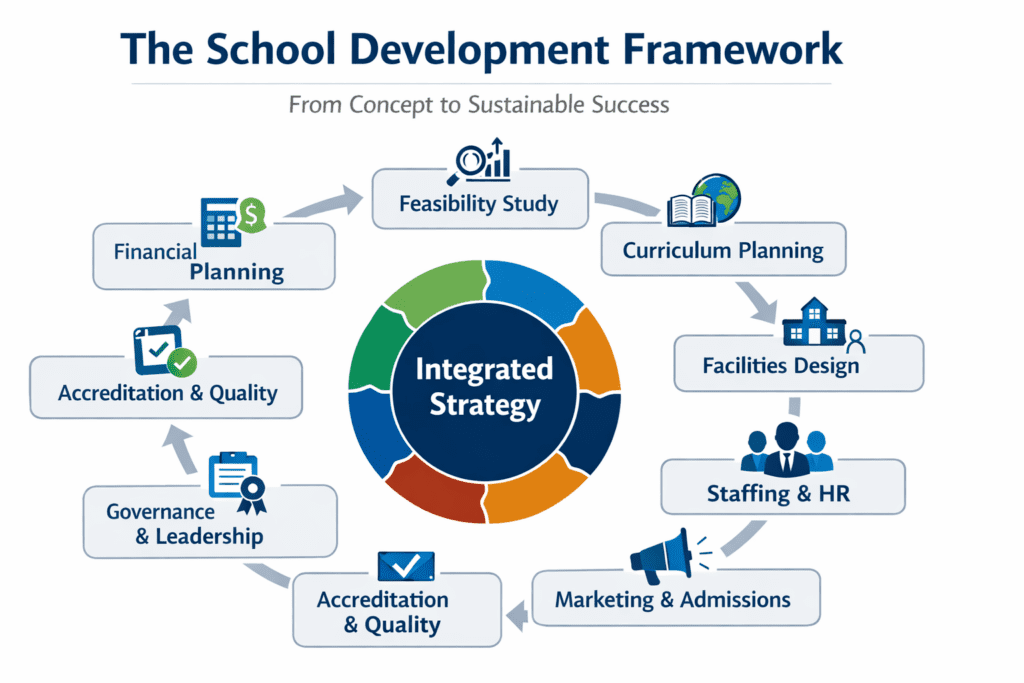
The Alternative: A Structured Development Framework
Projects that achieve long-term stability adopt a disciplined, integrated approach to school development. They recognise that success depends on sequencing decisions correctly and ensuring alignment across multiple domains.
A structured development framework typically integrates:
- Comprehensive feasibility analysis
- Market-aligned curriculum selection
- Phased infrastructure planning
- Strategic recruitment and leadership development
- Early enrolment planning and brand positioning
- Robust governance frameworks
- Accreditation-aligned quality assurance systems
This approach does not eliminate risk. However, it significantly reduces uncertainty and increases the likelihood of sustainable growth.
A Strategic Reflection
Schools are among the most complex organisations to establish. They operate at the intersection of education, real estate, governance, and community engagement. Their success depends not only on vision, but on disciplined execution and strategic sequencing.
Projects that approach school development as an integrated system rather than a collection of independent decisions consistently achieve stronger long-term outcomes.
In an increasingly competitive global education landscape, the difference between projects that struggle and those that thrive is rarely ambition or investment. It is the presence of a structured, coherent development strategy from the very beginning.
If you are exploring a new school project or reviewing an existing development strategy, you may find it useful to explore our structured framework outlining the key stages of school development:
[10 Steps to Setting Up a New School]
Frequently Asked Questions About School Development
1. Why do many new school development projects struggle?
Most school projects struggle not because of lack of investment or ambition, but due to poor sequencing of decisions. Common issues include unrealistic enrolment projections, premature capital expenditure on facilities, weak governance frameworks, and insufficient market research before launching.
2. What is the most important first step when setting up a new school?
The most critical first step is conducting a comprehensive feasibility study. This includes analysing demographic demand, competitor positioning, fee affordability, regulatory requirements, and long-term enrolment projections before making major investment decisions.
3. How long does it typically take to develop a new school?
From initial feasibility planning to full operational maturity, most school development projects take between three and five years. This timeline includes market research, design, regulatory approvals, construction, staffing, enrolment planning, and system development.
4. What is the biggest financial risk in school development?
The largest financial risk is investing heavily in facilities before validating market demand. Fixed infrastructure costs can place long-term pressure on operational sustainability if enrolment growth does not meet projections.
5. How should curriculum decisions be made in a new school project?
Curriculum selection should be based on market alignment, regulatory context, university pathway objectives, and staffing availability rather than perceived prestige. The chosen curriculum influences operational complexity, teacher recruitment, and long-term positioning.
6. Why is governance important in school development?
Strong governance structures ensure clarity of decision-making, accountability, and strategic oversight. Without defined governance frameworks, school projects often struggle to transition from founder-led initiatives to sustainable institutions.
7. When should marketing begin for a new school?
Marketing and enrolment planning should begin during the early feasibility phase, not just before opening. Early community engagement and brand positioning are essential to building enrolment momentum prior to launch.
8. What role does accreditation play in school development?
Accreditation should be treated as a design principle rather than an end milestone. Systems related to quality assurance, leadership, governance, and data management should align with accreditation standards from the outset.
9. What distinguishes successful school projects from unsuccessful ones?
Successful projects follow a structured development framework that integrates feasibility, curriculum planning, facilities design, staffing strategy, governance, marketing, and quality assurance in a disciplined sequence.
10. How can investors reduce risk when developing a new school?
Investors can reduce risk by adopting phased development models, conducting rigorous feasibility studies, ensuring strong governance frameworks, and aligning operational planning with realistic enrolment and financial projections.
11. Where can I learn more about the full school development process?
You can explore our comprehensive framework outlining the key stages of school planning, launch, and management here:
[10 Steps to Setting Up a New School]

Visit www.gsineducation.com to explore how we can help you achieve excellence in international education.